

I finished Stephen King's Cujo a week ago, which pushed me to start The Dead Zone, another novel written in his glory days before his freak accident, being hit while walking along a road. Another novel on my upcoming list is John Grisham's The Firm, which I am very excited to read. This past year has included the most novels that I have ever read, but it's all for good purpose.
Today, another author asked me to read a shorter piece of his. It was something different, an adult romance, and I gave it a good two hours of me commenting on it and making note of where conflict and scene goals are missing, something I myself have been missing through drafting and creating in revision.
And that's today's focus. Reading keeps the mind loose, the muse churning even when a writer closes up shop for the night. Like artists, we writers duplicate what we like from genres and writers we love. We throw out what he don't love, and that's that. Is this necessary for one to be a writer?
In a word: yes. Reading is just as important to writers as being bothersome is to a cuddling cat. The words we peel through in a novel, poem, or short work are what reload our own craft. Think of it like driving a car running purely on electricity, as cars these days tend to do.
You wouldn't fuel an electric car with water. Student writers try to do this by putting a piece off until the night before it's due. You wouldn't stare at the car and say you were driving it, yet young writers say they write when they actually only think of writing. Who does that?
A few friends and I had a good laugh, when one learned that a person he knew wrote in a genre he had never read.
Plain as the sun beating down on Death Valley, writers learn, grow, and feed in their craft by reading, writing, and assisting others through the process. Of course, meeting others and discussing writing can and should be a part of the work. Writing is solely not an activity for introverts. But the meat of what we do, repeated throughout the course of every writing reference you'll pick up, is gained by being a writer and reader.
Go and find yourself a good book, and start learning.
Subscribe!

 Posts
All Comments
Posts
All Comments
Showing posts with label inspiration. Show all posts
Showing posts with label inspiration. Show all posts
Sunday, June 8, 2014

Friday, April 18, 2014
Inspiration in Life for Writing
I walked into my Monday morning study session, eight-thirty. The room sat chilled from an open window and AC vent. Blinds shifted. Light bounced off the stained white-board. A table that looks taken from surgery stands at the end of the room, and I set my greying Disney backpack down.
After ten minutes, the first student walked in. She sat in the second row, third aisle. "Good morning, John."
"Morning." I wiped my eyes and drew a slash where her name listed on the attendance sheet. "Do the reading?"
"I have a question for you."
I blinked and set my folder aside. "About the reading?"
She nodded. She looked up at the ceiling and moved her hand in the air, fishing for the words that would soon come to her.
When I ask people what inspires them in writing, I am told about childhoods, friends, haunted houses, or food. When I tell people what inspires me, the answers tend to vary based on the day that I've been having.
I started writing in dark times. I didn't have a happy start to my craft. Yes, I grew up as a reader, just as almost every writer did. Many people think that writers are expected to start with a magical moment.
It's arguable to say that the start of a writer is not important. How did Hemingway begin? What made Stephen King get his first published novel? If you've read enough, you'll surely find out the answers. But one thing that stands a mystery is how these authors and more get started writing each and every day.
I watched my tutee as she thought about her question. At eight-thirty, not much thinking goes on unless one is used to the mental-stimulation.
"John," she said, "How does the use of verbs and nouns convey an author's tone or theme?"
A fly buzzed in the air. Below me, my legs dangled from my risen seat. I looked at her, mouth open, and my heart fluttered just a bit.
Inspiration comes to us like questions. Sometimes, we might be stewing on our thoughts for a while, waiting to see what comes out clearly. Other times, our ideas line up, and we're able to toss out something great that surprises even those who are prepared for anything.
I answered that student's question, and she left the session, an hour later, with new ideas to apply in her essay. Four days later, and I'm still pondering the thoughts this student might have, the questions she's waiting to ask. Like inspiration, they might come easy, but we'll have to wait for and see whatever comes out.
After ten minutes, the first student walked in. She sat in the second row, third aisle. "Good morning, John."
"Morning." I wiped my eyes and drew a slash where her name listed on the attendance sheet. "Do the reading?"
"I have a question for you."
I blinked and set my folder aside. "About the reading?"
She nodded. She looked up at the ceiling and moved her hand in the air, fishing for the words that would soon come to her.
When I ask people what inspires them in writing, I am told about childhoods, friends, haunted houses, or food. When I tell people what inspires me, the answers tend to vary based on the day that I've been having.
I started writing in dark times. I didn't have a happy start to my craft. Yes, I grew up as a reader, just as almost every writer did. Many people think that writers are expected to start with a magical moment.
It's arguable to say that the start of a writer is not important. How did Hemingway begin? What made Stephen King get his first published novel? If you've read enough, you'll surely find out the answers. But one thing that stands a mystery is how these authors and more get started writing each and every day.
I watched my tutee as she thought about her question. At eight-thirty, not much thinking goes on unless one is used to the mental-stimulation.
"John," she said, "How does the use of verbs and nouns convey an author's tone or theme?"
A fly buzzed in the air. Below me, my legs dangled from my risen seat. I looked at her, mouth open, and my heart fluttered just a bit.
Inspiration comes to us like questions. Sometimes, we might be stewing on our thoughts for a while, waiting to see what comes out clearly. Other times, our ideas line up, and we're able to toss out something great that surprises even those who are prepared for anything.
I answered that student's question, and she left the session, an hour later, with new ideas to apply in her essay. Four days later, and I'm still pondering the thoughts this student might have, the questions she's waiting to ask. Like inspiration, they might come easy, but we'll have to wait for and see whatever comes out.
Sunday, April 6, 2014
Typing under Deaf Ears
For the first time in my life, I had to miss a day of work due to illness. For me, it's a big deal (obviously), and I'm still a bit nervous about the whole thing. Really, it shouldn't be a big deal at all. Shouldn't it?
I drove home on the Sixty Freeway, and everything sounded muffled. My eyes darted across the highway as I looked for any trouble. My head pounded. Burning hotter than my truck's heater, my throat lining tasted like onions.
I got home after ten minutes, and immediately, I went to sleep. The next day came, and I had to call out. But from then on, my time in bed was spent with my typewriter or a book.
Sick days can be argued to have been made for writers. On a weekly basis, if our schedules are busy enough, we have to fight for a chance to put pen to paper, fingers to keyboard. Writing's a career that promises to torment you if you work a ten-hour job (or are a parent).
I pounded the keys of my fifty-year-old silent-super typewriter, striking a sheet of printer paper--silently. My ears ached. Everything had grown quieter a day after staying home. Conversations felt like shouting matches. Opening my jaw created a pop that shook my head. In a way, I liked it.
While writing is hard to get to do on a busy schedule, it's also very hard to have peace-and-quiet.
It's Sunday, five days after day-zero of my cold. I will be returning to work tomorrow, heavily medicated if need be, where writing will have to take the backseat. I feel better. It's not where I'd like my cold to be, but it's where it has to be. Also, my hearing is back.
Take the time to enjoy whatever life throws at you. Good or bad, it's how we react that makes the difference. Positivity is created by us, not anyone else. By Thursday, I'll surely miss being able to type under very, very clogged ears.
I drove home on the Sixty Freeway, and everything sounded muffled. My eyes darted across the highway as I looked for any trouble. My head pounded. Burning hotter than my truck's heater, my throat lining tasted like onions.
I got home after ten minutes, and immediately, I went to sleep. The next day came, and I had to call out. But from then on, my time in bed was spent with my typewriter or a book.
Sick days can be argued to have been made for writers. On a weekly basis, if our schedules are busy enough, we have to fight for a chance to put pen to paper, fingers to keyboard. Writing's a career that promises to torment you if you work a ten-hour job (or are a parent).
I pounded the keys of my fifty-year-old silent-super typewriter, striking a sheet of printer paper--silently. My ears ached. Everything had grown quieter a day after staying home. Conversations felt like shouting matches. Opening my jaw created a pop that shook my head. In a way, I liked it.
While writing is hard to get to do on a busy schedule, it's also very hard to have peace-and-quiet.
It's Sunday, five days after day-zero of my cold. I will be returning to work tomorrow, heavily medicated if need be, where writing will have to take the backseat. I feel better. It's not where I'd like my cold to be, but it's where it has to be. Also, my hearing is back.
Take the time to enjoy whatever life throws at you. Good or bad, it's how we react that makes the difference. Positivity is created by us, not anyone else. By Thursday, I'll surely miss being able to type under very, very clogged ears.
Friday, February 7, 2014
A Hobbit and Several Spiders
The bathroom is one of the only places in my home where I can escape to read another chapter or sentence without being disturbed. I pick the parent's bathroom, because there's a heater, and even if I've never felt a mid-western freeze, a cold seat is a cold seat with jeans or without. Sometimes, I get through a couple chapters. It really depends on the book.
Reading allows me to escape. Like many, I find that some books pull stress away better than others. Just recently, I finished J. R. R. Tolkien's The Hobbit. This was one book I actually was able to finish in bed. It wasn't because of my family, however.
Above the toilet in my parent's restroom looms a web that stretches from the window to the towel racks, and changing his place every visit, the spider is a bulb with matchsticks for legs. Flies hang, and dust weighs the web down further.
In The Hobbit, Bilbo handles giant, menacing spiders with the power of his one ring (which we all know without even having to read the damn thing). The spiders have his friends hang from cocoons, and their noses and toes poke out, letting Bilbo know who's who.
I didn't even realize this bug of mine was watching me until something fell and rolled down my bare-back one morning. I jumped from the seat, clothed (no, I wasn't doing anything, just reading). Standing, I hit the web. More touches me. Thankfully, the only person awake was my father, and he spends his time in the back, so he didn't hear me yelp like a wounded Old Yeller.
In comparison, the spiders in Tolkien's novel aren't that scary. They talk and plan, something we don't see from spiders. To me, this humanizes them and makes them no more scarier than the hairy guy in the Big Bird suit on TV. Real spiders, things, terrorize us because we as readers or viewers don't see the mind behind the creature, demon, or spirit. In literature, we see the effect it brings on the protagonists or unlucky side characters, but not once are we told why something does what it does. Worst of all, if our characters are weak or injured, our hearts begin to pound at these things.
My spider is still hanging over the toilet, but I duck my head as to not disturb him. He's gained some new trophies, and had I caught them, I wouldn't want someone to knock them into a bowl. It turns out this is a new spider, with even thinner legs and larger eyes. My spider, who I knocked and hollered at during those early morning hours, hangs in one corner, bundled up into a sack.
Reading allows me to escape. Like many, I find that some books pull stress away better than others. Just recently, I finished J. R. R. Tolkien's The Hobbit. This was one book I actually was able to finish in bed. It wasn't because of my family, however.
Above the toilet in my parent's restroom looms a web that stretches from the window to the towel racks, and changing his place every visit, the spider is a bulb with matchsticks for legs. Flies hang, and dust weighs the web down further.
In The Hobbit, Bilbo handles giant, menacing spiders with the power of his one ring (which we all know without even having to read the damn thing). The spiders have his friends hang from cocoons, and their noses and toes poke out, letting Bilbo know who's who.
I didn't even realize this bug of mine was watching me until something fell and rolled down my bare-back one morning. I jumped from the seat, clothed (no, I wasn't doing anything, just reading). Standing, I hit the web. More touches me. Thankfully, the only person awake was my father, and he spends his time in the back, so he didn't hear me yelp like a wounded Old Yeller.
In comparison, the spiders in Tolkien's novel aren't that scary. They talk and plan, something we don't see from spiders. To me, this humanizes them and makes them no more scarier than the hairy guy in the Big Bird suit on TV. Real spiders, things, terrorize us because we as readers or viewers don't see the mind behind the creature, demon, or spirit. In literature, we see the effect it brings on the protagonists or unlucky side characters, but not once are we told why something does what it does. Worst of all, if our characters are weak or injured, our hearts begin to pound at these things.
My spider is still hanging over the toilet, but I duck my head as to not disturb him. He's gained some new trophies, and had I caught them, I wouldn't want someone to knock them into a bowl. It turns out this is a new spider, with even thinner legs and larger eyes. My spider, who I knocked and hollered at during those early morning hours, hangs in one corner, bundled up into a sack.
Saturday, February 1, 2014
Further Confusion, a Not so Confusing Trip
Walking to a Safeway started my morning, and already, I had seen several convention goers in large animal costumes and uniforms from various anime shows. The sky was open, free of clouds, and the sun warmed me even with the sixty degree temperature. On my back, I carried my bag with a legal pad, box of business cards, and a copy of The Hobbit. Only thing I had forgotten was my room key.
Further Confusion (FC) is a convention that takes place in San Jose, California, and focuses on anthropomorphic animals and illustrations, something still popular since the years of Disney's The Lion King. Artists, writers, and costumers network and sell their wares and creations. Taking place in a hotel, the convention allows for parties as well, and even with no sense of smell, I can feel the alcohol radiate from the fox I pass by.
I reach the Safeway with my two roommates, both who are creators of these expensive suits. We pick up sandwich bread and bananas (non-organic due to price). Also, I take this chance to get breakfast. After a walk back, we collapse on our room's beds. A stack of newly purchased novels lay next to me. No spending, I tell myself.
Outside of buying stuff, there were panels to attend as well as hold. I didn't make it to any of the writing panels I wished to see, but I was on a panel with Kyell Gold and Watts Martin, two authors who are known around the fandom for their fiction. The panel discussed releasing stories and publishing. I focused more so on magazines, blogging and twitter. Questions were passed around for us until the two hours ended, and everyone went on his or her way.
For me, conventions and conferences present the opportunity to network, unlike what staying behind a keyboard and screen does. Publishers attend as well as fans, and several of my own friends are artists, like my roommates. They spent their time selling behind desks. I lumbered around when I could and helped if they needed it.
The most important thing for me, however, is getting grounded, and FC allows that. I get to remember my start as a writer, my stressful growth from where I once was. I attended these events with my partner at the time, more focused on the party aspect, but the real thing that draws myself and others is the passion. The time spent on the works seen crawls with it. When people state they wake up in the morning to write, illustrate, or sing, it shows here. It is inspiring, simply. And the energy pushed around gets me working.
For now, I'm back home and resting. I have started a new piece, and the novel I have been working through is also under heavy focus still. School is coming up, and work is still keeping me busy.
It's as though I have stepped out of a dream world, and reality is slowly coming back to me. The memories I've made this FC will stay with me, and I look forward to the next upcoming event on my schedule, The San Gabriel Valley Literary Festival. 2014 is turning out to be a great year, and I couldn't be happier.
Kyell gold is the author of Out of Position, Green Fairy, and other anthropomorphic texts. His work can be found on Sofawolf.com.
Information for The San Gabriel Valley Literary Festival can be found at SGVlitfest.com.
Further Confusion (FC) is a convention that takes place in San Jose, California, and focuses on anthropomorphic animals and illustrations, something still popular since the years of Disney's The Lion King. Artists, writers, and costumers network and sell their wares and creations. Taking place in a hotel, the convention allows for parties as well, and even with no sense of smell, I can feel the alcohol radiate from the fox I pass by.
I reach the Safeway with my two roommates, both who are creators of these expensive suits. We pick up sandwich bread and bananas (non-organic due to price). Also, I take this chance to get breakfast. After a walk back, we collapse on our room's beds. A stack of newly purchased novels lay next to me. No spending, I tell myself.
Outside of buying stuff, there were panels to attend as well as hold. I didn't make it to any of the writing panels I wished to see, but I was on a panel with Kyell Gold and Watts Martin, two authors who are known around the fandom for their fiction. The panel discussed releasing stories and publishing. I focused more so on magazines, blogging and twitter. Questions were passed around for us until the two hours ended, and everyone went on his or her way.
For me, conventions and conferences present the opportunity to network, unlike what staying behind a keyboard and screen does. Publishers attend as well as fans, and several of my own friends are artists, like my roommates. They spent their time selling behind desks. I lumbered around when I could and helped if they needed it.
The most important thing for me, however, is getting grounded, and FC allows that. I get to remember my start as a writer, my stressful growth from where I once was. I attended these events with my partner at the time, more focused on the party aspect, but the real thing that draws myself and others is the passion. The time spent on the works seen crawls with it. When people state they wake up in the morning to write, illustrate, or sing, it shows here. It is inspiring, simply. And the energy pushed around gets me working.
For now, I'm back home and resting. I have started a new piece, and the novel I have been working through is also under heavy focus still. School is coming up, and work is still keeping me busy.
It's as though I have stepped out of a dream world, and reality is slowly coming back to me. The memories I've made this FC will stay with me, and I look forward to the next upcoming event on my schedule, The San Gabriel Valley Literary Festival. 2014 is turning out to be a great year, and I couldn't be happier.
Kyell gold is the author of Out of Position, Green Fairy, and other anthropomorphic texts. His work can be found on Sofawolf.com.
Information for The San Gabriel Valley Literary Festival can be found at SGVlitfest.com.
Monday, November 25, 2013
Campus History That Lives
Not so long ago, The Conjuring, a film based off an actual paranormal investigation and exorcism during the 60s, came out on DVD. The story is changed a bit just to keep audiences watching as usual, I believe, but the recreations of paranormal activity are pretty similar to the real thing: wall banging, hair pulling, skin biting and clawing, and item throwing can happen. It was just the other night, during a class of mine, that I felt my school might actually be haunted.
It was a lecture during my Novel course, and I had my yellow legal pad out for me to take notes. We were discussing plot. I tried to think on how I could incorporate certain aspects into my current novel without pulling the fun from the characters.
The sound of a desk moving came from the room's left corner. There was a projector, table, and leaning poster of Pulp Fiction sitting against the wall, but they hadn't moved.
It had came from the other room, where the school's newspaper was made and edited. I read the newspaper whenever it comes out, and asides the occasional grammar error, it's pretty strong. Their room is placed next to the computer lab I was going to use for work, before I changed rooms due to lacking keys.
The Novel class would go until ten, and I asked myself what if the school was haunted like The Conjuring. Mt. San Antonio College (Mt. Sac) used to be a military hospital, first army then navy, during World War II. Not many students know this, and when they learn, it's a surprise.
Locations such as Mt. Sac are prone to paranormal activity. The history is right, and the constant construction changes the landscape every year. When a location is changed from what it once was, spirits tend to be disturbed. This is mostly seen in homes and hotels, but if a location is carrying enough emotion in the walls, anything can happen.
Which is why I wouldn't be surprised if Mt. Sac was haunted. While the desk could have been moved by a staff member, student, or custodian, it's easy to see where energy can be focused enough to yank an object for a couple of feet. The sound of boots clapping down an empty hallway would not be anything too far from real.
The lecture finished at the hour. I stayed behind to talk with a couple of classmates and our professor. We talked about movies, the ones people have to watch. After ten minutes, I looked at the clock, said goodnight, and walked the empty but lit corridors to a supposedly empty parking lot.
It was a lecture during my Novel course, and I had my yellow legal pad out for me to take notes. We were discussing plot. I tried to think on how I could incorporate certain aspects into my current novel without pulling the fun from the characters.
The sound of a desk moving came from the room's left corner. There was a projector, table, and leaning poster of Pulp Fiction sitting against the wall, but they hadn't moved.
It had came from the other room, where the school's newspaper was made and edited. I read the newspaper whenever it comes out, and asides the occasional grammar error, it's pretty strong. Their room is placed next to the computer lab I was going to use for work, before I changed rooms due to lacking keys.
The Novel class would go until ten, and I asked myself what if the school was haunted like The Conjuring. Mt. San Antonio College (Mt. Sac) used to be a military hospital, first army then navy, during World War II. Not many students know this, and when they learn, it's a surprise.
Locations such as Mt. Sac are prone to paranormal activity. The history is right, and the constant construction changes the landscape every year. When a location is changed from what it once was, spirits tend to be disturbed. This is mostly seen in homes and hotels, but if a location is carrying enough emotion in the walls, anything can happen.
Which is why I wouldn't be surprised if Mt. Sac was haunted. While the desk could have been moved by a staff member, student, or custodian, it's easy to see where energy can be focused enough to yank an object for a couple of feet. The sound of boots clapping down an empty hallway would not be anything too far from real.
The lecture finished at the hour. I stayed behind to talk with a couple of classmates and our professor. We talked about movies, the ones people have to watch. After ten minutes, I looked at the clock, said goodnight, and walked the empty but lit corridors to a supposedly empty parking lot.
Thursday, November 7, 2013
Nanowrimo and the Invasion of the Body Snatchers
On November 1st, precisely at twelve A.M. when everyone is to be asleep, select individuals are wiped clean of their existence. They are not the same person anymore; their name is a vague look back to the previous person who used to control the body. When they wake up, several hours later, they will get up, wash, and be changed forever.
It sounds like a thrilling Science Fiction film, but it's Nanowrimo, the latest craze to hit the literary world since hardcover books. Nanowrimo is an annual event where writers promise to finish fifty-thousand words of a working novel draft within a month, and each day is a contest to complete the much needed word count goal. It illustrates the ongoing challenges authors go through while expressing that anyone can write if they sit down, silence everything, and write.
But writing this much in a day is inhuman, alien even. Students, hobbyist, parents, and others take this challenge and become someone new. Their minds become driven to find the next plot point, the next story direction. Their fingers wriggle out in a flurry of typing. Even when away from a keyboard, the victim cannot control his or her hands as they wait to cling to a writing device. The host becomes, dare I say it, an author.
Nanowrimo is great because it sets a goal for these new authors. Its no weaker than a manuscript deadline an editor might give, nor is it weaker than one an author would put on himself alone. Individuals can finish fifteen-hundred words in an afternoon and say, hey, I'm really doing this.
Being an author is very difficult. While society might dictate that writing is simply play, it's not. We are paid little money, with little hope, to play the lottery with ourselves. Will this turn out as great as I thought? Who knows. Will I make it big? Why is this even a question? We writers write because we enjoy it, love it even. The rush of words coming from what feels like nowhere is cathartic, and we have to constantly fight ourselves for free time, something that is a luxury.
That's what Nanowrimo gives us: a helping hand. You must get through your first draft without looking back, you must write this within thirty days, and you must enjoy yourself. That's it. It will not make you an award-winning author, nor will it make you the next Stephenie Meyers. However, it will change you, make you into a new being that's determined, creative, inspired, and perhaps even a future author.
If you start talking about a spaceship or next big invasion, however, you're on your own.
It sounds like a thrilling Science Fiction film, but it's Nanowrimo, the latest craze to hit the literary world since hardcover books. Nanowrimo is an annual event where writers promise to finish fifty-thousand words of a working novel draft within a month, and each day is a contest to complete the much needed word count goal. It illustrates the ongoing challenges authors go through while expressing that anyone can write if they sit down, silence everything, and write.
But writing this much in a day is inhuman, alien even. Students, hobbyist, parents, and others take this challenge and become someone new. Their minds become driven to find the next plot point, the next story direction. Their fingers wriggle out in a flurry of typing. Even when away from a keyboard, the victim cannot control his or her hands as they wait to cling to a writing device. The host becomes, dare I say it, an author.
Nanowrimo is great because it sets a goal for these new authors. Its no weaker than a manuscript deadline an editor might give, nor is it weaker than one an author would put on himself alone. Individuals can finish fifteen-hundred words in an afternoon and say, hey, I'm really doing this.
Being an author is very difficult. While society might dictate that writing is simply play, it's not. We are paid little money, with little hope, to play the lottery with ourselves. Will this turn out as great as I thought? Who knows. Will I make it big? Why is this even a question? We writers write because we enjoy it, love it even. The rush of words coming from what feels like nowhere is cathartic, and we have to constantly fight ourselves for free time, something that is a luxury.
That's what Nanowrimo gives us: a helping hand. You must get through your first draft without looking back, you must write this within thirty days, and you must enjoy yourself. That's it. It will not make you an award-winning author, nor will it make you the next Stephenie Meyers. However, it will change you, make you into a new being that's determined, creative, inspired, and perhaps even a future author.
If you start talking about a spaceship or next big invasion, however, you're on your own.
Tuesday, October 1, 2013
Using Journalism as a Form of Character Creation
It's been a while since I last posted here. School is in session, and work has me making sure students are on their game most of the time. This leaves little room for me to write anything out of my Novel course's required chapters (the class being taught by John Brantingham himself).
When I'm free, however, I do find the time to draft short non-fiction pieces. I'm a huge fan of travel writing and watching a landscape come to life with just a few words. It's magic--the same magic which brought me into writing creatively. Even without traveling to my favorite city up north, I can at least describe it.
There's another purpose to being a fictional reporter. As a writer, I find myself constantly squabbling over how important it is to give a strong, detailed character illustrated by his or her actions. The mind can only see so much, so I have to put the character to work, just so everything becomes clear to the reader. In a recent, featured article in The Writer, Patrick Scalisi discusses how a writer can form stronger characters just by treating an exercise as if a professional, journalistic interview. It doesn't require the author to be a professional in journalism, as Scalisi argues, and it allows the writer to express any ideas while letting the character have his or her way.
Interested in non-fiction, I decided to give it a try with my latest character, Paul, a narcissistic cheater living two lives.. The interview piece is short, but I was able to see more so on the first layer of my character, Paul Greer, while understanding what he has to hide deep inside. Here's what came out:
When I'm free, however, I do find the time to draft short non-fiction pieces. I'm a huge fan of travel writing and watching a landscape come to life with just a few words. It's magic--the same magic which brought me into writing creatively. Even without traveling to my favorite city up north, I can at least describe it.
There's another purpose to being a fictional reporter. As a writer, I find myself constantly squabbling over how important it is to give a strong, detailed character illustrated by his or her actions. The mind can only see so much, so I have to put the character to work, just so everything becomes clear to the reader. In a recent, featured article in The Writer, Patrick Scalisi discusses how a writer can form stronger characters just by treating an exercise as if a professional, journalistic interview. It doesn't require the author to be a professional in journalism, as Scalisi argues, and it allows the writer to express any ideas while letting the character have his or her way.
Interested in non-fiction, I decided to give it a try with my latest character, Paul, a narcissistic cheater living two lives.. The interview piece is short, but I was able to see more so on the first layer of my character, Paul Greer, while understanding what he has to hide deep inside. Here's what came out:
The ferry roars into the docks and when
settled, its gates open to let out dripping tourists and locals, each
with cameras in their hands. Their ponchos glisten against the muted
background of San Francisco's bay, and I watch them peel the layers
away until they stand in jeans and sweaters.
One man stands in a polo-shirt and
pair of slacks. In his hand, he has a cell-phone and pair of bug-eyed
sunglasses.
Paul Greer works in Los Angeles as an
attorney and public speaker. For him, traveling up north is just
another day to add to his resume. We sit down on a bench in front of
the clock tower standing over Market Street, with sandwiches in our
hands, warm.
“My trips are usually centered on
wealthy businessmen, divorcing families, land owners.”
“Do you ever feel the drive's too
much?”
He smiles and I can see lettuce stuck
between his teeth. “It's worth it.”
For him, the cool winds overlap into
his burning world down south, where his family lives and works
without him. He brings them food, souvenirs, and portraits they
cannot get unless they spend the salary on traveling, something he
says is an arguable approach.
“My wife has a kid, and there's
another one on the way.”
“Does that upset you they'll be
growing up only seeing you half of the time?”
“We get used to it, and my son knows
a trip means toys, bread.” He takes another bite out of his
sandwich. “He's fond of those shaped bread loaves, from Boudin's.”
As we're talking, a group of students
rush to a halted street-car, the F-Line. The bell rings and the back
door opens. Passengers get out, and Paul watches. We wait for the
door to close and the tube of chrome to screech away.
“I never get used to this city. I
call it the city of love, and each drive up here is a new experience,
new dream.”
My sandwich begins to get cold as a
pelican waddles up, head turned and eyes watching me. “What does an
attorney dream of?”
He holds for a second when the bird
moves up, and his right foot lifts, scaring the pelican away.
“I've asked the same thing with the
Boogeyman, and I still haven't found an answer. I go where the money
is.”
“And is the money always in San
Francisco?”
He nods his head, bites the steaming
pastrami once more, and doesn't wait to speak. “Sometimes,” he
says. “Sometimes.”
John Brantingham is an author teaching in Southern California. His work can be found at johnbrantingham.blogspot.com.
The Writer is a monthly publication, which can be found online at Writermag.com.
"Character Profile," written by Patrick Scalisi, can be found here, http://www.writermag.com/2013/09/30/character-profile/
Thursday, August 22, 2013
Summer Travels
Napa, California, was something more than what I expected it to be. At first, I had heard it was where tourists visited to taste wine, get drunk, then regret it and move on back towards their work schedules and lives. My friends made it sound as though it was a location filled with older people three-times my age and up taking photos to show their grandchildren. My grandmother had planned it, and while she is older, I didn't take what my friends had said and applied it to her. Instead, I went with an open mind, a legal pad, and a plan.
My brother decided not to come with us, but that didn't stop the rest of us from enjoying ourselves. Of course, there's the wine, which starts at downtown Napa and leads up north past where he had stopped, a winery built within a renaissance-esque castle.
 But I wasn't there for wine. Instead, I was there with the opportunity to tell others I had been there, something much like the idea that it's more fun to have written than to actually write. I did taste wine, but it was too dry for me, and when I did find the wines I enjoyed, the one slipping my glasses gave me two bottles and a wave of the hand (I think my grandma bought three).
Wine is not the only taste of Napa, we learned, as I had spotted a diner filled with people out the front and down near the curb. Stopping, we had lunch and the burgers, much to my expectations, were amazing. As a write, I would make up some excuse to return and draft a novel, or an article such as this. But I would return in actuality to this very stand, and I would have another of their delicious bacon-cheeseburgers.
 Throughout the trip, my legal-pad sat in my Mickey Mouse labled backpack, and stories bled out of me unlike anything I had experienced before. Driving up the 5 at the start, I thought of a man driving home from a business conference to a static-filled radio; however, in the static, he hears the world ending and his loved ones dying. While trying to find our hotel, I illustrated the conflicts faced within five pages and thought of a gas-station attendant too bored out of her mind that she helped us. I sit here now remembering these incidents and tales, and it feels as though I could push them out as one reads this.
We left Napa only after a short stay and traveled to San Francisco, a city too close to my heart to forget. It's a different world in that several different cultures blend into one fondue of creativity, openness, and passion. Walking down the streets and seeing the filled cable cars demonstrates the passion these people hold while going to a Giants game. Visiting Milk Plaza and seeing a district built on rights and freedom is eye-opening to say the least. The music's not bad, either. In this way, traveling is an amazing way to see what's out there--artist, writer, student, or none.
 I travel with my family every summer, and even though some rides can be rough, the ability to capture an entire destination in words and pictures is astounding. Growing up, I never had the chance to see outside the walls of my family's homes. Now, as I travel to conferences, conventions, and possibly haunted locations, my life is able to become something much grander than what I had ever dreamed. Writers, spend some time out in the world and see what's out there to inspire you. Artists, visit the oceans, mountains, and sunsets, and capture it all in paint, sketch, or photography.
Families, don't bring your six-year-old to Napa and ask him why he won't keep quiet. He won't, so just go with it, and write it down.
My brother decided not to come with us, but that didn't stop the rest of us from enjoying ourselves. Of course, there's the wine, which starts at downtown Napa and leads up north past where he had stopped, a winery built within a renaissance-esque castle.

Wine is not the only taste of Napa, we learned, as I had spotted a diner filled with people out the front and down near the curb. Stopping, we had lunch and the burgers, much to my expectations, were amazing. As a write, I would make up some excuse to return and draft a novel, or an article such as this. But I would return in actuality to this very stand, and I would have another of their delicious bacon-cheeseburgers.

We left Napa only after a short stay and traveled to San Francisco, a city too close to my heart to forget. It's a different world in that several different cultures blend into one fondue of creativity, openness, and passion. Walking down the streets and seeing the filled cable cars demonstrates the passion these people hold while going to a Giants game. Visiting Milk Plaza and seeing a district built on rights and freedom is eye-opening to say the least. The music's not bad, either. In this way, traveling is an amazing way to see what's out there--artist, writer, student, or none.

Families, don't bring your six-year-old to Napa and ask him why he won't keep quiet. He won't, so just go with it, and write it down.
Thursday, June 27, 2013
Handling Rejection: Advice for the New Writer
When I first started writing, rejection was a weight in my stomach that never went away. Even today, it's still there, and with each story I send out, the weight grows stronger. But that's not what writing's about, I tell myself.
Yes, rejection is a natural part of the writing process. Some stories work with some magazines, and other stories need to be placed somewhere else--that's how the business works. However, we write because we have a story to tell, something that someone out there must know. For myself, it's the common struggle that minorities face every day as they work towards equality or a higher form of understanding. To others, it might be an action filled, horrifying tale of what happened during vacation. Now, in what part of these is there rejection?
It's crazy, but being a writer is all about, you guessed it, writing. Publishing is only a gold coin that adds flavor to our passion, so if one magazine doesn't accept our story, we can look at the story for what it is, maybe revise it a bit more, then move to the next magazine and see where it goes--that's it.
Writers carry such a burden with rejection, however, because it's their work--their children. To see our offspring be rejected is hard, and it does hurt. Writers need to remember, however, they are not being rejected as a person.
In Catch! A Fishmongers Guide to Greatness, Cyndi Crother and the World Famous Pike Place Fish crew discuss that when working, they carry a short motto that allows them to remember everything's not as bad as it seems. Their phrase is "it's all over here," meaning that whatever negative ideas that are thought are not from others, but from ourselves (16). When I first started writing, I felt that I would never get published. At the time, I felt that in order to be a writer, I needed to be published. Writing stories became difficult because I would want them perfect, and the pieces eventually just ended up in my laptop's recycle bin. However, once I let go that editors and publishers were out to destroy my work and mood, writing and submitting became easier.
And that's the most important thing: submitting and being rejected is easy. When someone asks if we would like a glass of water, and we say no, the other person hopefully is not hurt by our rejection. The same thing applies here, but editors feel that our work is not fit for their magazine. Well, what do we do after a rejection, then?
Send to another magazine and keep writing.
It takes courage to continue to send out stories, poems, and novels with the idea rejection could be there, but rejection is not a way to destroy us. Publishers and editors want our stories; they want someone to hear what we have to say. As writers, our job is to enjoy our passion and see who else possibly would like to tell our story.
It's been a year since my first story was accepted, and for twelve months I received a large amount of rejections. Instead of letting them burden me, I printed the first rejection I received and posted it on the wall, telling myself that it's just a piece of paper ("It's all over here"). As authors, our job is to tell a story, and someone out there wants to hear it. It might take time to find that person, but when we do find them, it's the best feeling ever.
Until then, we just keep writing.
Saturday, June 22, 2013
Redmond, Seattle, and the Haunted Saloon
For the past few years, vacation has been something hard to come by. School, work, and hobbies always came in the way. Thankfully, I had one week before the next intercession of my school begins and I return to work, so I took it upon myself to schedule a trip up northwest to Washington, a place that has always interested me due to its culture, history, and weather. Heading up there, I didn't know what to expect.
I stayed in a small apartment in a city near Seattle, called Redmond, known for Microsoft which is located near the highway. Waking up was an experience as the sounds of the trickling stream and pond behind my friend's cozy home eased me, and sleeping was orchestrated by toads and owls. The trip was spent here mostly, my friend and I watching horror movies and documentaries, but when we had the chance, we took the bus and headed towards Seattle.
The main focus within Seattle was to experience the culture and history of Washington. I grew up hearing about a city within the north built on the creativity and hard work of those who braved the constant rain. One major landmark of this would be the Pikes Place Farmers Market, and it was just amazing. For roughly a mile, vendors with a history of thirty plus years shouted, hooted, and welcomed passing tourists and shoppers into their stores of fresh fish, cheap books, and indie artwork.
The day went by fast, and eventually, my friend and I grew hungry but were low on money. Thanks to Yelp!, a local place was suggested and we made our way to Seattle's Merchant's Cafe and Saloon. It was said and written to be the oldest cafe and saloon within Seattle, something my friend said I had to experience even if she had never been there, and I ordered the grilled cheese with bacon and fresh fries; however, that was not the only thing that came with the meal: the location is haunted.
Yelp! comments stated that the ghosts were active on occasion, and immediately, I asked the host if the place truly was haunted. He stated, yes, it was, and things tend to happen on ocurrance. I took a shot and asked if I could investigate, and he instructed for me to head to the basement, where the restrooms are located, and to "do [my] thing." As soon as dinner ended, I was on my way with camera in hand--I wish I had my recorder, however.
The basement was illuminated more than I had anticipated, holding both a lounge and the restroom, but no one was down there at the time. Within stepping down the steps, the atmosphere felt heavier than upstairs. It wasn't negative, but it was noticeably different. I began to snap photos as my friend sat hirself (excuse the pronoun; she's agender, a division of the transgender community, and looked over the room, taking it in. After several shots, I captured orbs, supposed forms of energy that are manifested by spirits, but I knew that it was a poker game with such things. After spending a while downstairs, I said thank you and left.
Back home, I've looked back on the trip. Yes, I've gathered several stories that I wish to write, and I was able to pick up many trinkets and wet clothing along the way. It was sad leaving my friend of 7 years behind when I had just met her in person at the start of the week, but I hope to return or drag hir down to southern California another time.
I've looked through the photos of the Merchant's Saloon, and not much has stood out to me as far as what was captured, but I did find one photo that stood out to me. The world is full of skeptics, and orbs do have a tendency to get confused with dust and water particles, and even insects, but this orb out of all of the photos takes on an illumination of its own, and to compare, I've pasted a photo with dust below, followed by the orb. View it in an analytical perspective as you will--these photos have not been modified in any form, shape, or manner other than uploading into this post.
 | |
| Washington's known for its sprawling forest scenery and wet weather. |
 |
| A small distance from the apartment, this brook was a calm getaway for reading. |
 | |
| Pikes Place Farmers Market |
Yelp! comments stated that the ghosts were active on occasion, and immediately, I asked the host if the place truly was haunted. He stated, yes, it was, and things tend to happen on ocurrance. I took a shot and asked if I could investigate, and he instructed for me to head to the basement, where the restrooms are located, and to "do [my] thing." As soon as dinner ended, I was on my way with camera in hand--I wish I had my recorder, however.
The basement was illuminated more than I had anticipated, holding both a lounge and the restroom, but no one was down there at the time. Within stepping down the steps, the atmosphere felt heavier than upstairs. It wasn't negative, but it was noticeably different. I began to snap photos as my friend sat hirself (excuse the pronoun; she's agender, a division of the transgender community, and looked over the room, taking it in. After several shots, I captured orbs, supposed forms of energy that are manifested by spirits, but I knew that it was a poker game with such things. After spending a while downstairs, I said thank you and left.
Back home, I've looked back on the trip. Yes, I've gathered several stories that I wish to write, and I was able to pick up many trinkets and wet clothing along the way. It was sad leaving my friend of 7 years behind when I had just met her in person at the start of the week, but I hope to return or drag hir down to southern California another time.
I've looked through the photos of the Merchant's Saloon, and not much has stood out to me as far as what was captured, but I did find one photo that stood out to me. The world is full of skeptics, and orbs do have a tendency to get confused with dust and water particles, and even insects, but this orb out of all of the photos takes on an illumination of its own, and to compare, I've pasted a photo with dust below, followed by the orb. View it in an analytical perspective as you will--these photos have not been modified in any form, shape, or manner other than uploading into this post.
 |
| On the top right against the bricks, this can be argued as dust due to the translucent center and bright ring; also, it is in a dusty area of the basement against bricks. |
 |
| In contrast, up against the ceiling is an orb that seems to be illuminated on its own brighter than usual; compare to the photo above. |
Sunday, May 12, 2013
Mother, Where and How Art Thou
Growing up, I never saw my mother. That could be seen as a lie as I did see my mother, just rarely. I rarely saw my father too, and that can at times hurt a little; when I'm asked on who my parents are or what they do, I explain but don't go heavily into detail. With Mother's Day, that can be somewhat conflicting.
It's okay to have certain feelings, of course. That's what makes us human. I was raised on the edge of East Los Angeles by my grandparents until the age of fourteen, right around when my grandfather passed away due to unknown reasons (at least to me, for I've never asked my family how or why he died). But me and my brother were happy regardless of our folks, who spent the week working: our father was a truck driver, and our mother is still currently a supervisor at Southern California's Gas Company. We would visit them on weekends by means of car, picked up by our father, inhaling the smoke of his cigarettes as it would coat the windows in ash. I always told my parents I had reasons why I can't smell.
But the weekends were always happy memories. Mom would take us to the grocery store, and we would get cookies, fresh baked from the bakery. She would drive us early at dawn to Disneyland, a place that today is still a large part of my life for the memories we created; I'll never forget the week we took off of school to attend Disneyland's 50th Anniversary. I still have the souvenirs from that weekend.
Sadly, our father was in a serious car accident that crippled him to a permanent limp. I don't remember how old I was, but again, I didn't know the severity at the time--he was delivering food to the local Mcdonald's on Central ave in Chino, when a car spread through parking lot, ran him over the hood and left him on the ground with a broken neck.
He got back up and went straight to work until he could work no more.
However, Mom pushed through it and still drove us where she could, cooked what we enjoyed, and took care of the house while Dad was recuperating. He never grew stronger, so he sits in the living room on a large leather chair. He watches television and reads, doing what he can to help.
When I was in second grade, I had a freak accident and broke my right femur, supposedly the strongest bone in my body (of course, I took it to the challenge to prove science wrong). Immediately I was taken to the hospital by my grandmother, who phoned my mother. I was medicated and fell asleep under the pain, waking up occasionally to scream; the memory of crying at night with the cold, rigid metal brace against my back and mangled thigh is something I'll never forget. When I awoke, Mom was there, and for the next three months, working to get healthy so I could be home for Christmas, I found her staying at the side of my bed through the tears and joy. It wasn't until a week ago that I learned she was told by the doctor at the time I might have had bone cancer due to the broken femur. She told me, as I prepared for work, that she cried hard that day.
And now when I'm soon to reach 21, a serious achievement for me after a couple of years of stress and fear, she is still there for me--for us--taking care of the family the best she can. Dad's unable to work due to his handicap, but he gets a check in from time to time, and Mom works every day of the week, late or early, and she even works weekends--the woman has 8 weeks worth of vacation saved for crying out loud.
Growing older as an young author, I look back to see what parts of my history could make a story that affects people inside. The idea of changing someones life and proving to them they're not alone is something I strive for, and it's difficult. It really is. When ideas are dry, and the game system calls me, however, I think on my family, and especially my mother. She's showed me out of everyone that it's possible to have the strength to do anything, and I thank her for that.
Now, if only I had the strength to clean my room.
It's okay to have certain feelings, of course. That's what makes us human. I was raised on the edge of East Los Angeles by my grandparents until the age of fourteen, right around when my grandfather passed away due to unknown reasons (at least to me, for I've never asked my family how or why he died). But me and my brother were happy regardless of our folks, who spent the week working: our father was a truck driver, and our mother is still currently a supervisor at Southern California's Gas Company. We would visit them on weekends by means of car, picked up by our father, inhaling the smoke of his cigarettes as it would coat the windows in ash. I always told my parents I had reasons why I can't smell.
But the weekends were always happy memories. Mom would take us to the grocery store, and we would get cookies, fresh baked from the bakery. She would drive us early at dawn to Disneyland, a place that today is still a large part of my life for the memories we created; I'll never forget the week we took off of school to attend Disneyland's 50th Anniversary. I still have the souvenirs from that weekend.
Sadly, our father was in a serious car accident that crippled him to a permanent limp. I don't remember how old I was, but again, I didn't know the severity at the time--he was delivering food to the local Mcdonald's on Central ave in Chino, when a car spread through parking lot, ran him over the hood and left him on the ground with a broken neck.
He got back up and went straight to work until he could work no more.
 |
| Mom on the Las Vegas strip during a vacation. |
However, Mom pushed through it and still drove us where she could, cooked what we enjoyed, and took care of the house while Dad was recuperating. He never grew stronger, so he sits in the living room on a large leather chair. He watches television and reads, doing what he can to help.
When I was in second grade, I had a freak accident and broke my right femur, supposedly the strongest bone in my body (of course, I took it to the challenge to prove science wrong). Immediately I was taken to the hospital by my grandmother, who phoned my mother. I was medicated and fell asleep under the pain, waking up occasionally to scream; the memory of crying at night with the cold, rigid metal brace against my back and mangled thigh is something I'll never forget. When I awoke, Mom was there, and for the next three months, working to get healthy so I could be home for Christmas, I found her staying at the side of my bed through the tears and joy. It wasn't until a week ago that I learned she was told by the doctor at the time I might have had bone cancer due to the broken femur. She told me, as I prepared for work, that she cried hard that day.
And now when I'm soon to reach 21, a serious achievement for me after a couple of years of stress and fear, she is still there for me--for us--taking care of the family the best she can. Dad's unable to work due to his handicap, but he gets a check in from time to time, and Mom works every day of the week, late or early, and she even works weekends--the woman has 8 weeks worth of vacation saved for crying out loud.
Growing older as an young author, I look back to see what parts of my history could make a story that affects people inside. The idea of changing someones life and proving to them they're not alone is something I strive for, and it's difficult. It really is. When ideas are dry, and the game system calls me, however, I think on my family, and especially my mother. She's showed me out of everyone that it's possible to have the strength to do anything, and I thank her for that.
Now, if only I had the strength to clean my room.
Monday, February 18, 2013
San Gabriel Valley LitFest & Semester Update
I've decided to come out of my cave for once. Over the weekend I went to the San Gabriel Valley Literary Festival, which is a new event located in West Covina. I dropped by on Saturday, after having my brakes clunk to junk on Thursday, so I wasn't able to make it to the Friday open-mic events. When I got there in the morning after some trouble, 12:15 to be precise--which I guess is noon--I started by going to a literary magazine's reading. The day continued with reading after reading, until finally I made my leave at three for errands. But it was all fantastic.
This would be my first literary festival outside of regular fandom conventions, and the same feeling of mutual appreciation was there, but focused devotedly on writing and literature. I wish I could have returned for Sunday, so next year I'll be sure to clear it up, and come April when Mt Sac. hosts their writer's conference, I'll be there to socialize and learn--socialization seems to be my weakest point.
Learning, however, is something I will continue to be doing until that point, with Mt. Sac returning to school next Monday. I only have Math, Literature, and one training course, but I will be tutoring students within the classroom and I'm excited.
And as far as my writing goes, with the bumps and bruises along the way, I have several stories revised and ready to ship out. I've been working on a book, too: It's a sci-fi horror story taking place on a large military ship, called The Neptune. I'm taking it slow, learning the process of writing a much larger story, but I'm having fun doing it (or at least I think I do). My chapters run quite a bit short, but I'm not too worried about it right now; the plot is giving me shivers as I go.
To all those returning to school, good luck, have fun, and drive safely the first few days; being from Mt. Sac, it's easy to see how a parking lot can become a focal point of trauma throughout someone's life.
This would be my first literary festival outside of regular fandom conventions, and the same feeling of mutual appreciation was there, but focused devotedly on writing and literature. I wish I could have returned for Sunday, so next year I'll be sure to clear it up, and come April when Mt Sac. hosts their writer's conference, I'll be there to socialize and learn--socialization seems to be my weakest point.
Learning, however, is something I will continue to be doing until that point, with Mt. Sac returning to school next Monday. I only have Math, Literature, and one training course, but I will be tutoring students within the classroom and I'm excited.
And as far as my writing goes, with the bumps and bruises along the way, I have several stories revised and ready to ship out. I've been working on a book, too: It's a sci-fi horror story taking place on a large military ship, called The Neptune. I'm taking it slow, learning the process of writing a much larger story, but I'm having fun doing it (or at least I think I do). My chapters run quite a bit short, but I'm not too worried about it right now; the plot is giving me shivers as I go.
To all those returning to school, good luck, have fun, and drive safely the first few days; being from Mt. Sac, it's easy to see how a parking lot can become a focal point of trauma throughout someone's life.
Tuesday, January 22, 2013
A Bittersweet Return
After a week of being away in San Jose, I have returned to sunny Southern-California, where the temperature on arrival was eighty degrees and the sinus just punched me in the nose. It feels good to be back in my own bed, with my laptop whirring underneath my fingers. I missed it, and I certainly missed my usual writing schedule.
The convention went very well. I arrived anxious and stressed, making sure my itinerary was followed to the margin, but ended up relaxing and resting my eyes on the train. Eventually, I met up with a friend's boyfriend in San Francisco. We dropped off our things at the house, then hung around the city until my friend came home from work. Until the late hours of the night, we worked to help prepare her art table for the weekend.
We arrived in San Jose the next day, and my blood-pressure was through the skylights. The convention takes place within a hotel, and throughout the many corridors, elevators, and the large, adjacent Convention Center next door, the energy of excitement flows through each guest. When the next day came, that feeling was multiplied, and it continued to grow.
The artistry I see at these events is amazing. Each year, no matter what location, I find myself surprised, excited, and entertained with the things people create, whether in fiction, or digital art and paintings. I look at my friend, Christine Knopp, and constantly question how she does half the things she does. I remember that people the same way about us writers--I don't even know how I do what I do.
During the day, I met with the folks at Sofawolf Press, the team who has welcomed me to their literature magazine with open "paws." I discussed a bit with Jeff Eddie, and can't wait to work with him on my short-story. I also had to pick up a copy of Divisions, by Kyell Gold--signed, too!
But with the weekend over, everyone returned home to their family, pets, and loved ones, I'm back to work and writing. My novella is towards the end, and will need heavy revision when the time comes; some of the big plot points need to be looked at and decided whether or not they fit. I have several short-stories revised and edited, too. I'm not sure where to send them, but I'll find somewhere, even if it means I pay Duotropes new fee policy.
It's always a hard time returning back to reality, but I plan to return to the convention with high expectations, and maybe with a few more stories published.
Wednesday, December 12, 2012
Spooks, Spectors, And Nonsense
As the days grow colder, the nights much darker, it's easy to feel that holiday cheer warm your heart. Hot Cocoa, warm fires, and the pleasing glow of a neighbor's obnoxious lawn decoration. But I'm not here to talk about that.
Even with the season of giving upon us, my interests still fall into the category of creepy and eerie: the paranormal. A few posts ago, as well as the large discussion of why I write, seen on my blog, I mentioned my interests in ghosts. They're the unknown figures that stand in the hallway late at night; the watchful eye over your shoulder even later at night, or even the hand that grabs you during the day, and turning to look you find no one there (let's at least hope you find no one there. Society's full of creeps these days).
But it's not the fear that draws me. It's the idea of a possible living, once-breathing creature still roaming Earth, unknown and unexplainable. While that does tie into the fear, it only draws me in further, and forces me to discuss the activities present with others. Of course, that's easier said than done--who wants to talk about ghosts other than that one guy?
My interests started as a kid at my grandparent's home. It was on the edge of East Los Angeles, and each night there would be the occasional footstep, creak, or even shudder. Of course, our grandpa enjoyed staying up during the night, and he did drink, doing random stuff at random times, but most of the time it wasn't home--all the times I stayed up it wasn't him. Other than that, my time with the paranormal was restricted to television specials on Travel Channel, which, believe me, were far better than some bro's swearing at ghosts and laughing at each other.
But then I got into acting, which allowed me to travel to well-known, and sometimes old, desolate places. We filmed a deleted-scene for Constantine in the pool of the KnickerBocker Hotel in Hollywood, California, which has reports of Marylin Manroe's spirit appearing all over the hotel in lobby mirrors and upstair rooms. On one cold night I was filmed at the Universal Backlot, and footsteps could be heard where no one else was walking. I was able to visit places I had only heard of being haunted, and it gave me a rush.
After a few years, my family and I started to take trips to San Francisco, which is such a beautiful, regal city--but it's haunted, too. I've always wanted to go across the bay to the prison, Alcatraz Island, but they would have to pry me away from the island by my cold, dead hands. On the way home from the bay, we always stop by The Winchester Mystery House, a towering feat of architecture built by the blueprints of spirits.

Even with the season of giving upon us, my interests still fall into the category of creepy and eerie: the paranormal. A few posts ago, as well as the large discussion of why I write, seen on my blog, I mentioned my interests in ghosts. They're the unknown figures that stand in the hallway late at night; the watchful eye over your shoulder even later at night, or even the hand that grabs you during the day, and turning to look you find no one there (let's at least hope you find no one there. Society's full of creeps these days).
But it's not the fear that draws me. It's the idea of a possible living, once-breathing creature still roaming Earth, unknown and unexplainable. While that does tie into the fear, it only draws me in further, and forces me to discuss the activities present with others. Of course, that's easier said than done--who wants to talk about ghosts other than that one guy?
My interests started as a kid at my grandparent's home. It was on the edge of East Los Angeles, and each night there would be the occasional footstep, creak, or even shudder. Of course, our grandpa enjoyed staying up during the night, and he did drink, doing random stuff at random times, but most of the time it wasn't home--all the times I stayed up it wasn't him. Other than that, my time with the paranormal was restricted to television specials on Travel Channel, which, believe me, were far better than some bro's swearing at ghosts and laughing at each other.
But then I got into acting, which allowed me to travel to well-known, and sometimes old, desolate places. We filmed a deleted-scene for Constantine in the pool of the KnickerBocker Hotel in Hollywood, California, which has reports of Marylin Manroe's spirit appearing all over the hotel in lobby mirrors and upstair rooms. On one cold night I was filmed at the Universal Backlot, and footsteps could be heard where no one else was walking. I was able to visit places I had only heard of being haunted, and it gave me a rush.
After a few years, my family and I started to take trips to San Francisco, which is such a beautiful, regal city--but it's haunted, too. I've always wanted to go across the bay to the prison, Alcatraz Island, but they would have to pry me away from the island by my cold, dead hands. On the way home from the bay, we always stop by The Winchester Mystery House, a towering feat of architecture built by the blueprints of spirits.

The house was owned by Sarah Winchester, and, supposedly due to the spirits of her father's company, she was forced to build the house in odd, difficult pathways, confusing the spirits.
Believe what you feel on its construction, the home itself has had many visitors arrive and encounter paranormal occurrences. During the one hour, above ground tour, we were at the part of the mansion that was destroyed during the San Francisco earthquake. Part of the house had crumbled, as well as had a fire, but eventually it had been rebuilt until Sarah Winchester's death--it still remains unfinished to this day. While in that wing of the manor, a fan, plugged into the wall, stopped suddenly, turning off. Nothing else was affected--lights, etc--and upon leaving that spot, the fan started to spin again. Another year, me and my mom took the behind-the-scenes tour, which forces you to wear hardhats and travel underneath the home. It was creepy, but upon reaching a certain room, where the sun should have beamed through the glass, warming us, we all were hit with a solid cold breeze out of nowhere, the room shivering. "Cold spots," as investigators title them, are a sign of spirits entering a room, or being present. The tour continued on, and that spot was never cold again when we came back--as it should, having no air vents or open windows.
In my own home, I've experience walking in to find my dumbbell weights stacked vertically on my chair; I've woken up to find my bed sheets tugged away and at the other side of the room; I've walked outside my room, late at night, to feel someone sitting in the living room, staring at me, watching me in the darkness before sending me back to my room, still feeling followed.
Nothing has happened for the past two years, and I'm thankful for that--I like my ghosts, but not as much as I love my sleep. I've been looking into visiting The Queen Mary, a haunted cruise ship in Long Beach, California, and spending the night in one of their haunted hotel rooms. For now, however, my time with the paranormal is kept mostly to my stories, looking for ways to creep others out and to further understand them. Who knows, by writing more eerie, mind-racing horror stories, I might bring some spirits over to visit me. I just hope they know and follow my sleep schedule.
Thursday, November 22, 2012
Why I Write
Today a bunch of us writers are trying out a little experiment; each writer, listed below with their names and blogs, will post why they write, and how they grew into a writer.
I grew up in East Los Angeles with my grandparents and younger brother. My parents, living in Chino where I reside now, were always busy with work, and had no time to take care of us. My father was a trucker, and Mom was, and still is, a supervisor for the Southern California Gas Company. We would visit them on the weekends, but during the week it was just me and my twin-brother with the grandparents.
We didn't have much to do there, and the internet wasn't out. My brother was very much into scary stories, and I was into the discovery and study of Paranormal activity (great kids, right?). The house had its own weird happenings, so on occasion we would stay up, in pitch darkness, and just watch for anything. Of course, we would get too scared to stay up past twelve, and School was something we did, so we would never go past ten at the latest. But it was exciting.
I grew up with a bunch of kids who, like me, had a huge imagination. They weren't into the Paranormal like I was, but we enjoyed the same television shows. Eventually we got tired of playing these stories on the School's yard, and we moved onto our next big adventure: comics and stories. I wrote the dialogue, stories, descriptions, and dabbled a bit in drawing, but I was never as good as the others in art. These were the kids who spent hours drawing, and could turn out a new masterpiece within minutes (masterpieces, however, were restricted to the use of crayons and markers). We moved throughout our years continuing to create stories together. Eventually we passed on out of Middle School and had to move on.
After the loss of my Grandfather, and missing the nights we would tell each other stories, my brother and I was asked to move to my parent's home in Chino by the state. We followed, and ended up going to the High School just around the block, but we were horrified. The years of scary stories and Ghost-hunting led to us dressing up as punks, and we were forced to attend a School where we had no friends to compare with. Of course we were the outsiders, but it didn't stay like that for long.
My brother was known for his crazy ways and long, feminine hair. I gained friends thanks to my imagination and creativity. I joined the Japanese Animation and Art club, and hours after school, for four years, were devoted to Marching Band. I wanted to do theatre, having done acting as a child growing up, but our parents grid-locked us into making music. The years went by so quickly, and I had lost my spark in creating stories.
After a few years I went into a medical scare--Cancer. I had gained an odd lump in my throat, and the mole on my chest was seen as an oddity to the doctors. They removed both things for testing, but I was traumatized; days were spent in bed, crying, and I was eventually forced onto anxiety medication. I fell out of an abusive relationship at the time as well, the person not helping me in the slightest, so things were grim.
I started to attend therapy on campus for free. My mother was against it, saying my anxiety and trauma was nothing at all, but I was tired of the nightmares, crying fits, and general sulking that went on. The therapy didn't help much asides giving me someone to talk to, which was good, but I needed answers, solutions, and for my problems to just "fuck off." Then I found a book.
The Tools, by Phil Stutz and Barry Michels, is what I'd like to think saved me. There I found techniques, tools, as they called it, to help combat my fears. I was amazed that books could do this for me, and while I grew up reading stories, novellas and novels, this was something incomparable. Immediately I talked with my friends, and told them what was inside. I was a missionary trying to tell of the Lord's graces. Then I began to write.
And I wrote more.
And I wrote more.
Things were pouring out, and my grades in English were soaring high. Immediately I wanted to do this; immediately I wanted to write something that could change someone's life, or show them that they're not alone--no one has to go through this alone. I started writing dramas, romances, and even realistic, horrifying thrillers. I was hooked.
I moved on to the next level of college, where thanks to my professor at the time I met my now mentor, John Brantingham. I awkwardly called him one day and told him I just wanted to writer--to know how to do the things these people did. We met up in his office and I showed him a trio of stories I threw together. He talked with me on what I was doing well, and not-so-well, but encouraged me to continue whether it be through our School's writing club, or the class. Again, I was hooked.
I now tutor English and Writing at my School's Writing-center. My writing schedule takes over my entire day, as I make sure to write no less than 500 words (my goal, however, is to keep at 1000 words a day). I write and read every day, and make sure not to drop off the ball. If I can't write anything up to that amount, I keep it to a 500 word essay, or journal.
Literature is a great thing, and in some way has influenced me throughout life. While it also might have saved my life, it's pushed me forward into a new, positive direction, where I can actually see a future for myself (majoring in acting or Italian were some of the silly things I thought of during my first years in College). Moving forward, I want to become an Editor as of this point, but continue to write encouraging, thrilling, or just plain horrifying stories that show the wonders, troubles, and accomplishments of real, every day life.
Below are the links to the other authors who are writing about their appreciation of this wonderful craft. Feel free to visit, and give writing a chance yourself!
I grew up in East Los Angeles with my grandparents and younger brother. My parents, living in Chino where I reside now, were always busy with work, and had no time to take care of us. My father was a trucker, and Mom was, and still is, a supervisor for the Southern California Gas Company. We would visit them on the weekends, but during the week it was just me and my twin-brother with the grandparents.
We didn't have much to do there, and the internet wasn't out. My brother was very much into scary stories, and I was into the discovery and study of Paranormal activity (great kids, right?). The house had its own weird happenings, so on occasion we would stay up, in pitch darkness, and just watch for anything. Of course, we would get too scared to stay up past twelve, and School was something we did, so we would never go past ten at the latest. But it was exciting.
I grew up with a bunch of kids who, like me, had a huge imagination. They weren't into the Paranormal like I was, but we enjoyed the same television shows. Eventually we got tired of playing these stories on the School's yard, and we moved onto our next big adventure: comics and stories. I wrote the dialogue, stories, descriptions, and dabbled a bit in drawing, but I was never as good as the others in art. These were the kids who spent hours drawing, and could turn out a new masterpiece within minutes (masterpieces, however, were restricted to the use of crayons and markers). We moved throughout our years continuing to create stories together. Eventually we passed on out of Middle School and had to move on.
After the loss of my Grandfather, and missing the nights we would tell each other stories, my brother and I was asked to move to my parent's home in Chino by the state. We followed, and ended up going to the High School just around the block, but we were horrified. The years of scary stories and Ghost-hunting led to us dressing up as punks, and we were forced to attend a School where we had no friends to compare with. Of course we were the outsiders, but it didn't stay like that for long.
My brother was known for his crazy ways and long, feminine hair. I gained friends thanks to my imagination and creativity. I joined the Japanese Animation and Art club, and hours after school, for four years, were devoted to Marching Band. I wanted to do theatre, having done acting as a child growing up, but our parents grid-locked us into making music. The years went by so quickly, and I had lost my spark in creating stories.
After a few years I went into a medical scare--Cancer. I had gained an odd lump in my throat, and the mole on my chest was seen as an oddity to the doctors. They removed both things for testing, but I was traumatized; days were spent in bed, crying, and I was eventually forced onto anxiety medication. I fell out of an abusive relationship at the time as well, the person not helping me in the slightest, so things were grim.
I started to attend therapy on campus for free. My mother was against it, saying my anxiety and trauma was nothing at all, but I was tired of the nightmares, crying fits, and general sulking that went on. The therapy didn't help much asides giving me someone to talk to, which was good, but I needed answers, solutions, and for my problems to just "fuck off." Then I found a book.
The Tools, by Phil Stutz and Barry Michels, is what I'd like to think saved me. There I found techniques, tools, as they called it, to help combat my fears. I was amazed that books could do this for me, and while I grew up reading stories, novellas and novels, this was something incomparable. Immediately I talked with my friends, and told them what was inside. I was a missionary trying to tell of the Lord's graces. Then I began to write.
And I wrote more.
And I wrote more.
Things were pouring out, and my grades in English were soaring high. Immediately I wanted to do this; immediately I wanted to write something that could change someone's life, or show them that they're not alone--no one has to go through this alone. I started writing dramas, romances, and even realistic, horrifying thrillers. I was hooked.
I moved on to the next level of college, where thanks to my professor at the time I met my now mentor, John Brantingham. I awkwardly called him one day and told him I just wanted to writer--to know how to do the things these people did. We met up in his office and I showed him a trio of stories I threw together. He talked with me on what I was doing well, and not-so-well, but encouraged me to continue whether it be through our School's writing club, or the class. Again, I was hooked.
I now tutor English and Writing at my School's Writing-center. My writing schedule takes over my entire day, as I make sure to write no less than 500 words (my goal, however, is to keep at 1000 words a day). I write and read every day, and make sure not to drop off the ball. If I can't write anything up to that amount, I keep it to a 500 word essay, or journal.
Literature is a great thing, and in some way has influenced me throughout life. While it also might have saved my life, it's pushed me forward into a new, positive direction, where I can actually see a future for myself (majoring in acting or Italian were some of the silly things I thought of during my first years in College). Moving forward, I want to become an Editor as of this point, but continue to write encouraging, thrilling, or just plain horrifying stories that show the wonders, troubles, and accomplishments of real, every day life.
Below are the links to the other authors who are writing about their appreciation of this wonderful craft. Feel free to visit, and give writing a chance yourself!
Kyle
Van Sant http://pkvansant.blogspot.com/
Charlotte
San Juan charlottesanjuan.wordpress.com
Marta
Chausee http://martachausee.blogspot.com/
Cora
Ramos http://coraramos-cora.blogspot.com/
Melodie
Campbell http://funnygirlmelodie.blogspot.com/
Lesley
Diehl http://anotherdraught.blogspot.com
Jim
Callan www.jamesrcallan.com/blog
Chris
Swinney http://clswinney.com
Carole
Avila http://caroleavilablog.wordpress.com/
Augie
Hicks http://augiecorner.blogspot.com
Sunday, November 4, 2012
Beta-Readers And The Art of Tutoring
Hey everyone! First off, I’m posting tonight in need of a few people. I’m working hard towards getting published, amongst my time tutoring and teaching, and I’m getting nothing but positive comments from my professor. While that’s nice to hear, and is a very good thing for a writer to know, I still need a few folks I can rely on to give me constructive opinions on my writing.
Moving on now, I'm interested in discussing a bit about my current experiences in tutoring English, a job I've had for just around a month. It's a fun job that forces me to be social in situations I can't control, which to say is very good for me as a person. Most of my days are spent behind this dusty, music screaming laptop without any interaction outside my home beyond the internet. If lucky, I get to hang with friends, and if not--time for writing.
1. John Brantingham can be found here, on blogger, at http://www.johnbrantingham.blogspot.com .
I’m pretty divided when it comes to what I write; some days I write more human stories while the rest I focus my hand at anthropomorphic creatures. Furthermore, a majority of my stories fall under horror, suspense, sociology of every day life, and some other genres. You don’t need to be into these genres, but it can help me if you are.
Obviously I won’t be able to pay you, but I can acknowledge you with gratitude, and I only hope you find joy in helping someone further their career and passion. If you’re interested please note me here with a cover letter explaining any experience, education, or creative background you feel might help. Again, I’m not looking for you to be interested in my genres, or be a fellow tutor of the English language, but it would certainly help. Thank you!
Obviously I won’t be able to pay you, but I can acknowledge you with gratitude, and I only hope you find joy in helping someone further their career and passion. If you’re interested please note me here with a cover letter explaining any experience, education, or creative background you feel might help. Again, I’m not looking for you to be interested in my genres, or be a fellow tutor of the English language, but it would certainly help. Thank you!
Moving on now, I'm interested in discussing a bit about my current experiences in tutoring English, a job I've had for just around a month. It's a fun job that forces me to be social in situations I can't control, which to say is very good for me as a person. Most of my days are spent behind this dusty, music screaming laptop without any interaction outside my home beyond the internet. If lucky, I get to hang with friends, and if not--time for writing.
But tutoring allows me to meet new people, learn their stories, and show my compassionate, creative side to others. I joke with our director, Dr. David Charbonneau, that I care too much some times. He laughs at me and says that's fine, but don't help too much or skip appointments. If only it was as easy to do the former as he says.
Furthermore, tutoring strengthens my knowledge more than students I'm working with (genius, as I say!). My professor and some-what of a mentor in creative-writing, John Brantingham(1), brought this up during one of our class sessions. He mentioned that our knowledge is built stronger by teaching someone because we hear it for the second time, an enforce it into our minds. I like to joke that that's a double-edged blade, but sadly it's not a joke, and forces me to make sure my understanding is concise and correct.
Tutoring is a great way to improve not only as a writer, but as a respectable person in society. You hear so many stories of growth from students, and learn how people deal with society now in its tragic, strenuous occurrences. I've learned so much about people, and feel I will only learn more about society and the human heart as time goes on. My stories will improve; my understanding of life will improve. Not only does this push me further into a career I can enjoy, but I get payed too. That's kind of a plus, I guess.
1. John Brantingham can be found here, on blogger, at http://www.johnbrantingham.blogspot.com .
Friday, October 26, 2012
What Goes Bump In The Mind
When it comes to literature, of any form, I really enjoy a good horror story; ghost, werewolf, apocalypse, mutation, or demon stories are my favorites. From those I would have to say Ghost stories play a huge role as to who I am as a writer, and storyteller.
I grew up in the east end of Los Angeles, California, with my grandparents and twin-brother. Our parents always worked, so we didn't have any support at home, which is why we lived so far from them. Our grandparents raised us for fourteen years, and that came with everything from schoolwork and sickness, to punishments and summer vacations. Of course we saw Mom and Dad occasionally but it wasn't enough for us. Not only weren't we able to see them, but it felt as though our grandparent's home was a much creeper place than it was.
We would hear the floorboards creaking, footsteps down the hall, and other strange, unexplainable noises (the creaking could have been the house shifting, but it moved across the hallway and living room when heard). Late at night, during the summer, me and my brother would be forced to bed when the sensation of being watched from behind grew too much. It was eerie enough to make us stay up late at night to see what would happen, ultimately running to our room.
Asides from our childhood, which seems to be a story of its own, I've had several encounters with the paranormal throughout my life: visiting San Francisco, one of the cities I've grown attached to, a trip to the Queen Anne Hotel has given me physical proof that spirits are seen as living energy; walking through the labyrinth of the Winchester Mystery House's upper floors, as well as basement, revealed that people do linger behind after death, and can cause odd things to occur many years later. Even in our own home, we've had things moved on their own, bed sheets tugged away, and an ominous sensation of being followed.
As a writer I'm drawn to the paranormal because I think it amplifies a fear that we all can agree we have: fear of the unknown. Will it harm us? Do spirits talk? How can I feel comfortable in my own home if a stranger is always watching me? The unknown forces the reader, or person it's interacting with, to understand that there are some things out there that we might not have control over, and having no understanding of it just makes it a bit more startling. How can you stop a murderer if you have no understanding as to how or why he does what he does? How can you escape a paranormal entity if it follows you on end without reason?
With that in mind, explore what makes you startled, or something that's out of your control and completely a mystery to you. Halloween is the perfect time to understand your fears, weaknesses, and even your strengths. Just know that whatever is watching you from outside the window is there to help you in your creative pursuits--or to watch as you sleep.
Below are two photos of spirit-orbs from the Queen Anne Hotel in San Francisco, California.

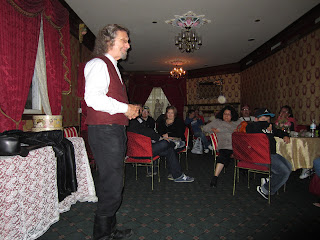
I grew up in the east end of Los Angeles, California, with my grandparents and twin-brother. Our parents always worked, so we didn't have any support at home, which is why we lived so far from them. Our grandparents raised us for fourteen years, and that came with everything from schoolwork and sickness, to punishments and summer vacations. Of course we saw Mom and Dad occasionally but it wasn't enough for us. Not only weren't we able to see them, but it felt as though our grandparent's home was a much creeper place than it was.
We would hear the floorboards creaking, footsteps down the hall, and other strange, unexplainable noises (the creaking could have been the house shifting, but it moved across the hallway and living room when heard). Late at night, during the summer, me and my brother would be forced to bed when the sensation of being watched from behind grew too much. It was eerie enough to make us stay up late at night to see what would happen, ultimately running to our room.
Asides from our childhood, which seems to be a story of its own, I've had several encounters with the paranormal throughout my life: visiting San Francisco, one of the cities I've grown attached to, a trip to the Queen Anne Hotel has given me physical proof that spirits are seen as living energy; walking through the labyrinth of the Winchester Mystery House's upper floors, as well as basement, revealed that people do linger behind after death, and can cause odd things to occur many years later. Even in our own home, we've had things moved on their own, bed sheets tugged away, and an ominous sensation of being followed.
As a writer I'm drawn to the paranormal because I think it amplifies a fear that we all can agree we have: fear of the unknown. Will it harm us? Do spirits talk? How can I feel comfortable in my own home if a stranger is always watching me? The unknown forces the reader, or person it's interacting with, to understand that there are some things out there that we might not have control over, and having no understanding of it just makes it a bit more startling. How can you stop a murderer if you have no understanding as to how or why he does what he does? How can you escape a paranormal entity if it follows you on end without reason?
With that in mind, explore what makes you startled, or something that's out of your control and completely a mystery to you. Halloween is the perfect time to understand your fears, weaknesses, and even your strengths. Just know that whatever is watching you from outside the window is there to help you in your creative pursuits--or to watch as you sleep.
Below are two photos of spirit-orbs from the Queen Anne Hotel in San Francisco, California.


Thursday, October 4, 2012
Writing: Getting Started
Writing always comes off as a difficult, however, rewarding craft. Many youth and students start with the occasional class poetry, short stories, and the academic essay. College seems to focus more on proving your logic and arguments through a series of given evidence and background on the subject. Other classes, more advanced, of course, focus on the analyzation of modern literature, or even the bible, and its effect on the mind and society. These all are things people struggle with when it comes to school--let's not even get started with math--but how would a student even get started with writing? After having attended several classes, and working with students in the Writing Center on campus, it has come to my attention that there's the biggest question of all: "how do I even get started?"
I started a new position at my College's Writing Center as an english tutor. A majority of the students who visit want assistance on grammar, punctuation, and simply to "just write the damn thing for me." Asides from my work, I spend my Thursday nights in a creative-writing class, led by John Brantingham (link provided below). John spends three hours with students, including myself, to explain the writing process and mind frame of a writer; furthermore, the class forms into a workshop setting, where all students are required to show their best respect to others, be professional, or they will get a swift kick out the door. I can't help but imagine what would actually happen if someone was disrespectful enough. The class has many questions of course, and the students range from basic to publishing in their skills. He explains that Character, conflict, and desire are the three major points of story (Brantingham). From there, a student writer could move the story forward.
Essay writers are less understanding when it comes to this idea. Academic writers don't want to jump in. They know that in order to construct a strong argument, research and good sources are needed. They are afraid that once they get started, everything will be chiseled permanent into a block of granite. If you tell them to just start, they will look at you as if you just dropped a cat several stories. Essays are planned to the bricks, while fiction is all about what happens next. So, what happens next? Just like John Brantingham mentioned, character, conflict, and desire are all very important. From that point on, in my mind, it's all up to the characters what they wish to do next. Let them run free; let them fuck up their lives. You as the writer must only show us what happens, and the characters are what drives this baby forward. If there's a murderer on their heels then show us how they hide in the closet with their sniffles projected past the door, and if they just lost their wife, well, show us how they fight against alcoholism and understand that they are better than that. Not only does this feel spontaneous, but it is spontaneous--that's life. Even with the use of CCD (conflict, character, desire), many argue that inspiration plays a big part--not so, says others.
In his book On Writing, Stephen King describes that "'read a lot, write a lot' is the Great Commandment [of writing]" (151). "I used to tell interviewers that I wrote every day except for Christmas, the Fourth of July, and my birthday. That was a lie...I write every day, workaholic dweeb or not" (King 153). When starting to write fiction, the best way, that I've learned, is to just start writing. Start with the action or drama; start with the tears or fears; start with the arguments, but whatever you do don't wait around for your inspiration to save you. Matching that phrase from a popular video-game, the muse is a lie. Reading every day allows the writer to learn from others: the greats and masters. They play a role as your instructor, and can ease any misunderstanding such as how to write dialogue well. Writing every day allows the creativity to flow; with your mind constantly in creative drive, it's easier to write your next upcoming stories than waiting around for them to come.
Of course, there are many ways for writers to get their stories down on the page. Outlines and plot summaries, with the assistance of research, help some while others keep away from the outlines like it's a rabies infected hornets nest--I choose the latter to an extent. In reality it's what works best for you and gets you working. Don't wait for the muse to sweep you off your feet; the muse is a gold-digging-hussy, only stealing your precious time.
Stephen King's On Writing: A Memoir of The Craft--Tenth Anniversary Edition was used in this essay.
John Brantingham's website is http://johnbrantingham.webs.com/
He also has a blog, here, at http://johnbrantingham.blogspot.com/
I started a new position at my College's Writing Center as an english tutor. A majority of the students who visit want assistance on grammar, punctuation, and simply to "just write the damn thing for me." Asides from my work, I spend my Thursday nights in a creative-writing class, led by John Brantingham (link provided below). John spends three hours with students, including myself, to explain the writing process and mind frame of a writer; furthermore, the class forms into a workshop setting, where all students are required to show their best respect to others, be professional, or they will get a swift kick out the door. I can't help but imagine what would actually happen if someone was disrespectful enough. The class has many questions of course, and the students range from basic to publishing in their skills. He explains that Character, conflict, and desire are the three major points of story (Brantingham). From there, a student writer could move the story forward.
Essay writers are less understanding when it comes to this idea. Academic writers don't want to jump in. They know that in order to construct a strong argument, research and good sources are needed. They are afraid that once they get started, everything will be chiseled permanent into a block of granite. If you tell them to just start, they will look at you as if you just dropped a cat several stories. Essays are planned to the bricks, while fiction is all about what happens next. So, what happens next? Just like John Brantingham mentioned, character, conflict, and desire are all very important. From that point on, in my mind, it's all up to the characters what they wish to do next. Let them run free; let them fuck up their lives. You as the writer must only show us what happens, and the characters are what drives this baby forward. If there's a murderer on their heels then show us how they hide in the closet with their sniffles projected past the door, and if they just lost their wife, well, show us how they fight against alcoholism and understand that they are better than that. Not only does this feel spontaneous, but it is spontaneous--that's life. Even with the use of CCD (conflict, character, desire), many argue that inspiration plays a big part--not so, says others.
In his book On Writing, Stephen King describes that "'read a lot, write a lot' is the Great Commandment [of writing]" (151). "I used to tell interviewers that I wrote every day except for Christmas, the Fourth of July, and my birthday. That was a lie...I write every day, workaholic dweeb or not" (King 153). When starting to write fiction, the best way, that I've learned, is to just start writing. Start with the action or drama; start with the tears or fears; start with the arguments, but whatever you do don't wait around for your inspiration to save you. Matching that phrase from a popular video-game, the muse is a lie. Reading every day allows the writer to learn from others: the greats and masters. They play a role as your instructor, and can ease any misunderstanding such as how to write dialogue well. Writing every day allows the creativity to flow; with your mind constantly in creative drive, it's easier to write your next upcoming stories than waiting around for them to come.
Of course, there are many ways for writers to get their stories down on the page. Outlines and plot summaries, with the assistance of research, help some while others keep away from the outlines like it's a rabies infected hornets nest--I choose the latter to an extent. In reality it's what works best for you and gets you working. Don't wait for the muse to sweep you off your feet; the muse is a gold-digging-hussy, only stealing your precious time.
Stephen King's On Writing: A Memoir of The Craft--Tenth Anniversary Edition was used in this essay.
John Brantingham's website is http://johnbrantingham.webs.com/
He also has a blog, here, at http://johnbrantingham.blogspot.com/
Subscribe to:
Posts (Atom)