

For the first time in my life, I had to miss a day of work due to illness. For me, it's a big deal (obviously), and I'm still a bit nervous about the whole thing. Really, it shouldn't be a big deal at all. Shouldn't it?
I drove home on the Sixty Freeway, and everything sounded muffled. My eyes darted across the highway as I looked for any trouble. My head pounded. Burning hotter than my truck's heater, my throat lining tasted like onions.
I got home after ten minutes, and immediately, I went to sleep. The next day came, and I had to call out. But from then on, my time in bed was spent with my typewriter or a book.
Sick days can be argued to have been made for writers. On a weekly basis, if our schedules are busy enough, we have to fight for a chance to put pen to paper, fingers to keyboard. Writing's a career that promises to torment you if you work a ten-hour job (or are a parent).
I pounded the keys of my fifty-year-old silent-super typewriter, striking a sheet of printer paper--silently. My ears ached. Everything had grown quieter a day after staying home. Conversations felt like shouting matches. Opening my jaw created a pop that shook my head. In a way, I liked it.
While writing is hard to get to do on a busy schedule, it's also very hard to have peace-and-quiet.
It's Sunday, five days after day-zero of my cold. I will be returning to work tomorrow, heavily medicated if need be, where writing will have to take the backseat. I feel better. It's not where I'd like my cold to be, but it's where it has to be. Also, my hearing is back.
Take the time to enjoy whatever life throws at you. Good or bad, it's how we react that makes the difference. Positivity is created by us, not anyone else. By Thursday, I'll surely miss being able to type under very, very clogged ears.
Subscribe!

 Posts
All Comments
Posts
All Comments
Showing posts with label typewriters. Show all posts
Showing posts with label typewriters. Show all posts
Sunday, April 6, 2014

Sunday, March 9, 2014
Stepping into the Past: Using Typewriters in 2014
My father stopped me from pouring orange-juice into a mason jar. Oatmeal still in the microwave, I set the glass and carton down to see what he wanted. He asked me to lift an orange suitcase. I did, and we set it on the counter near my glass.
We opened to find that his 60-year-old typewriter had returned from repairs, clean and polished, keys waiting to be pressed. The carbon receipt he was given sat against the roller.
"Type something," Dad said.
I tapped a key, but nothing showed from the light touch. I pressed on the I key, and a line of ink appeared after a silver hammer thwacked the ribbon.
Dad raised his arm and nodded.
My mind focused on the machine, and I forgot about the bowl of oats waiting for me. Letters became words, and at the end of the line, a bell went off. I slid the roller to the right until the bell rang again, and I typed more.
We finished and closed the lid. Dad loped to his chair in the dark, and I took my breakfast to my room.
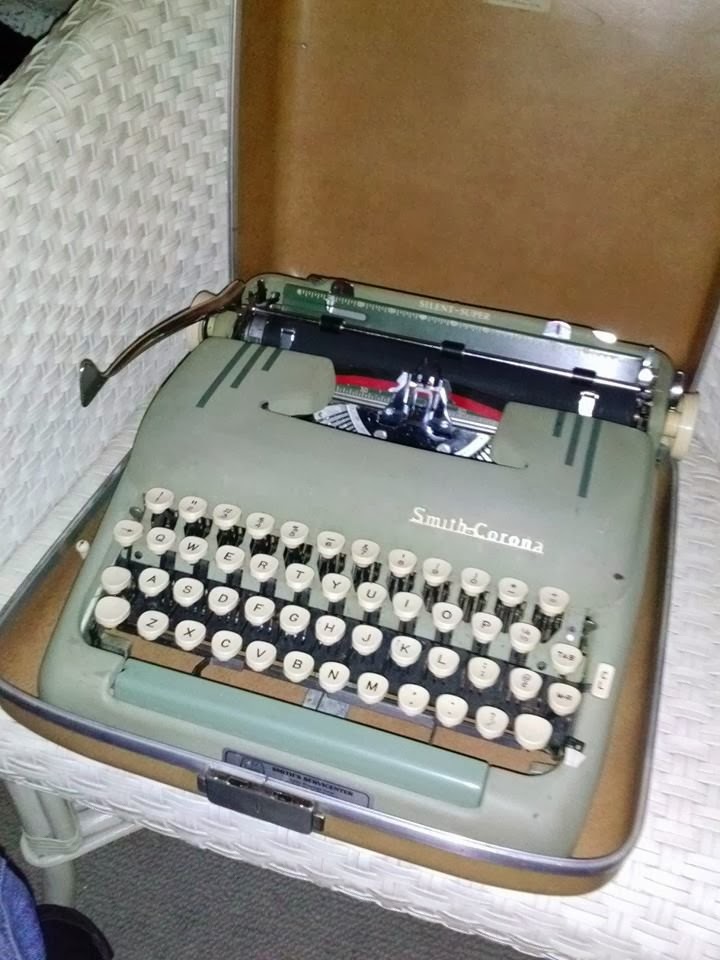
I tried the Smith-Corona typewriter again today when I decided to write my friend Sawyer a letter. Ze (hir preferred, androgynous pronouns are hir and ze) lives in Washington state, specifically forty minutes away from Seattle. The lines of ink coated a once blank sheet of paper. Because of the pressure needed, I had to backspace and hit the letters again, setting some of the words darker.
My father watched me from his chair, and Mom sat near him, sprawled out on the couch with chips in a bowl. Each time the bell went off, he smiled. She focused on the television. The Waltons were on, a show she never missed. The thwacks of hammers made her and the cat peek over.
It's an amazing experience being able to use a typewriter. Unlike laptops, which allow authors to vomit ideas out and fix later, typewriters require patience, perfection. One error means stopping, rolling away the lever, and blotting out letters with correction-fluid. Instead, I let the errors, however little there were, come out, and I told my friend how I am still getting used to it.
The errors, to me, are part of the magic. My parents found the machine in the garage, a mess with sticking keys and scratched parts. With it working and alive, breathing under my fingers, the errors feel right. Hemingway used a typewriter after he drafted in pencil and paper. Other authors, surely, tried their best to create the next masterpiece. When one uses a typewriter, the music of the bells and clicks are just a part of the meticulous work involved.
I plan to use the typewriter for letters and nonfiction pieces. The reality and age feels right with nonfiction, and using the typewriter, everything feels cultural. California is full of history, and maybe this is a way for me to experience classic California from the comfort of my living room or foyer. I am sure my friend, Sawyer, will be glad to find hir letter done in real, fresh pressed ink.
The smell of it on my hands, I am told, is pretty great, too.
We opened to find that his 60-year-old typewriter had returned from repairs, clean and polished, keys waiting to be pressed. The carbon receipt he was given sat against the roller.
"Type something," Dad said.
I tapped a key, but nothing showed from the light touch. I pressed on the I key, and a line of ink appeared after a silver hammer thwacked the ribbon.
Dad raised his arm and nodded.
My mind focused on the machine, and I forgot about the bowl of oats waiting for me. Letters became words, and at the end of the line, a bell went off. I slid the roller to the right until the bell rang again, and I typed more.
We finished and closed the lid. Dad loped to his chair in the dark, and I took my breakfast to my room.
I tried the Smith-Corona typewriter again today when I decided to write my friend Sawyer a letter. Ze (hir preferred, androgynous pronouns are hir and ze) lives in Washington state, specifically forty minutes away from Seattle. The lines of ink coated a once blank sheet of paper. Because of the pressure needed, I had to backspace and hit the letters again, setting some of the words darker.
My father watched me from his chair, and Mom sat near him, sprawled out on the couch with chips in a bowl. Each time the bell went off, he smiled. She focused on the television. The Waltons were on, a show she never missed. The thwacks of hammers made her and the cat peek over.
It's an amazing experience being able to use a typewriter. Unlike laptops, which allow authors to vomit ideas out and fix later, typewriters require patience, perfection. One error means stopping, rolling away the lever, and blotting out letters with correction-fluid. Instead, I let the errors, however little there were, come out, and I told my friend how I am still getting used to it.
The errors, to me, are part of the magic. My parents found the machine in the garage, a mess with sticking keys and scratched parts. With it working and alive, breathing under my fingers, the errors feel right. Hemingway used a typewriter after he drafted in pencil and paper. Other authors, surely, tried their best to create the next masterpiece. When one uses a typewriter, the music of the bells and clicks are just a part of the meticulous work involved.
I plan to use the typewriter for letters and nonfiction pieces. The reality and age feels right with nonfiction, and using the typewriter, everything feels cultural. California is full of history, and maybe this is a way for me to experience classic California from the comfort of my living room or foyer. I am sure my friend, Sawyer, will be glad to find hir letter done in real, fresh pressed ink.
The smell of it on my hands, I am told, is pretty great, too.
Subscribe to:
Posts (Atom)