

Work is starting up, and the goal for this summer amidst work is
finishing my book. It's not something like a chore, but it's more of a
push as to what will result in the end. Something will come out of the
rough draft, and something different will be made in the revision.
Beta-readers will look at this for what they see and each find something
different. The process is going strong, but I hope that along the way
my patience doesn't shrink thin.
A year ago, I started a novel project that had touched my imagination: what would someone do if they were being called by the dead and supposedly dying via his radio, in the middle of nowhere? EVP, or Electric Voice Phenomena, happens quite a bit in the paranormal community, with individuals finding clear voices telling them ghostly messages.
But this novel isn't about EVP, at least in my eye. I've worked with the novel for a year, and the focus has changed from a simple question to a character trying to relive a past that he never had through his son.
The result, as of right now, is a character lying, cheating, and even killing to get home and away from these demonic voices coming from technology. I've written over 48,000 words, and the end is coming sooner than expected, which is honestly more terrifying to me than what I'm writing about. It just can't end yet.
I've taken time away and back to the novel to help postpone the process. Some ideas come to me easily or feel they come out of the characters themselves, but in other case, pushing through has become a nuisance of what's crap and what's not (Shitty first drafts, Anne Lammott states). To get away from these thoughts, I've taken up archery, and I've learned that I'm okay at it. I hit the center several times this past Friday, one round being entirely of bullseyes.
Also, the sport relaxes me. For an hour, I can shoot arrows at a wall, sweating my shirt off in a building with no air-conditioning, yet I leave feeling great, maybe even energized.It's something I look forward to each week.
I miss the days when my novel really surprised and pushed me, much like archery is doing now. Things felt easier. I felt more accomplished after a good session, while now I feel accomplished but drained in some form. Is it the work load of my writing(1000 words)? Is it the time of day (Evenings before, afternoons now)? I'll have to take each day in front of the laptop and word processor as a new day, and if I don't get myself going on it, hope or not, no one will.
Subscribe!

 Posts
All Comments
Posts
All Comments
Showing posts with label literature. Show all posts
Showing posts with label literature. Show all posts
Sunday, June 22, 2014

Sunday, June 8, 2014
Learning through Experiencing, Helping
I finished Stephen King's Cujo a week ago, which pushed me to start The Dead Zone, another novel written in his glory days before his freak accident, being hit while walking along a road. Another novel on my upcoming list is John Grisham's The Firm, which I am very excited to read. This past year has included the most novels that I have ever read, but it's all for good purpose.
Today, another author asked me to read a shorter piece of his. It was something different, an adult romance, and I gave it a good two hours of me commenting on it and making note of where conflict and scene goals are missing, something I myself have been missing through drafting and creating in revision.
And that's today's focus. Reading keeps the mind loose, the muse churning even when a writer closes up shop for the night. Like artists, we writers duplicate what we like from genres and writers we love. We throw out what he don't love, and that's that. Is this necessary for one to be a writer?
In a word: yes. Reading is just as important to writers as being bothersome is to a cuddling cat. The words we peel through in a novel, poem, or short work are what reload our own craft. Think of it like driving a car running purely on electricity, as cars these days tend to do.
You wouldn't fuel an electric car with water. Student writers try to do this by putting a piece off until the night before it's due. You wouldn't stare at the car and say you were driving it, yet young writers say they write when they actually only think of writing. Who does that?
A few friends and I had a good laugh, when one learned that a person he knew wrote in a genre he had never read.
Plain as the sun beating down on Death Valley, writers learn, grow, and feed in their craft by reading, writing, and assisting others through the process. Of course, meeting others and discussing writing can and should be a part of the work. Writing is solely not an activity for introverts. But the meat of what we do, repeated throughout the course of every writing reference you'll pick up, is gained by being a writer and reader.
Go and find yourself a good book, and start learning.
Today, another author asked me to read a shorter piece of his. It was something different, an adult romance, and I gave it a good two hours of me commenting on it and making note of where conflict and scene goals are missing, something I myself have been missing through drafting and creating in revision.
And that's today's focus. Reading keeps the mind loose, the muse churning even when a writer closes up shop for the night. Like artists, we writers duplicate what we like from genres and writers we love. We throw out what he don't love, and that's that. Is this necessary for one to be a writer?
In a word: yes. Reading is just as important to writers as being bothersome is to a cuddling cat. The words we peel through in a novel, poem, or short work are what reload our own craft. Think of it like driving a car running purely on electricity, as cars these days tend to do.
You wouldn't fuel an electric car with water. Student writers try to do this by putting a piece off until the night before it's due. You wouldn't stare at the car and say you were driving it, yet young writers say they write when they actually only think of writing. Who does that?
A few friends and I had a good laugh, when one learned that a person he knew wrote in a genre he had never read.
Plain as the sun beating down on Death Valley, writers learn, grow, and feed in their craft by reading, writing, and assisting others through the process. Of course, meeting others and discussing writing can and should be a part of the work. Writing is solely not an activity for introverts. But the meat of what we do, repeated throughout the course of every writing reference you'll pick up, is gained by being a writer and reader.
Go and find yourself a good book, and start learning.
Sunday, March 9, 2014
Stepping into the Past: Using Typewriters in 2014
My father stopped me from pouring orange-juice into a mason jar. Oatmeal still in the microwave, I set the glass and carton down to see what he wanted. He asked me to lift an orange suitcase. I did, and we set it on the counter near my glass.
We opened to find that his 60-year-old typewriter had returned from repairs, clean and polished, keys waiting to be pressed. The carbon receipt he was given sat against the roller.
"Type something," Dad said.
I tapped a key, but nothing showed from the light touch. I pressed on the I key, and a line of ink appeared after a silver hammer thwacked the ribbon.
Dad raised his arm and nodded.
My mind focused on the machine, and I forgot about the bowl of oats waiting for me. Letters became words, and at the end of the line, a bell went off. I slid the roller to the right until the bell rang again, and I typed more.
We finished and closed the lid. Dad loped to his chair in the dark, and I took my breakfast to my room.
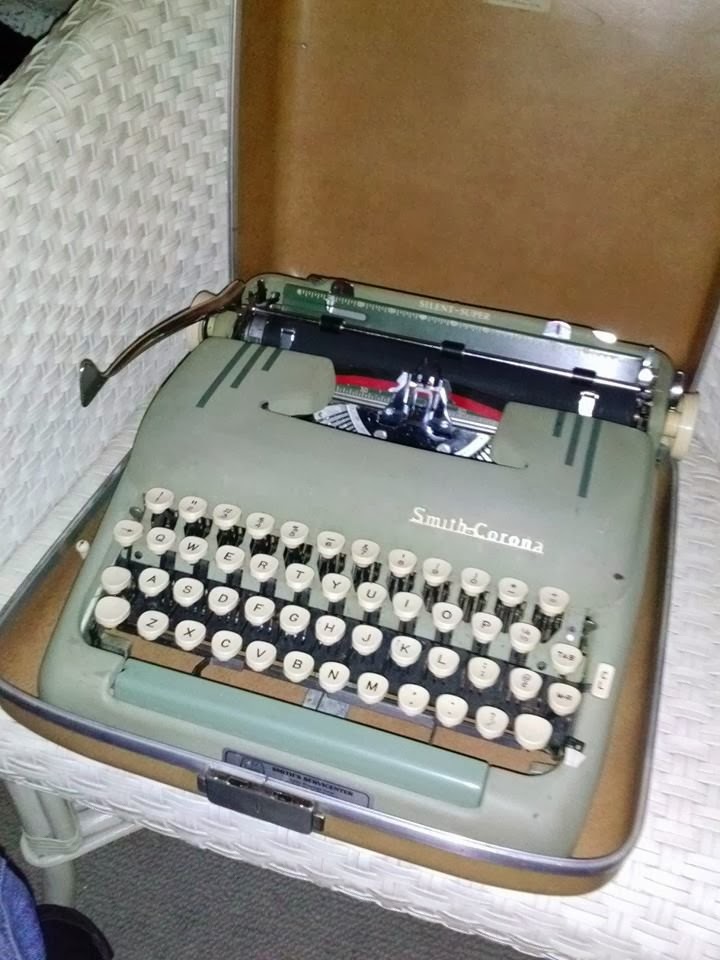
I tried the Smith-Corona typewriter again today when I decided to write my friend Sawyer a letter. Ze (hir preferred, androgynous pronouns are hir and ze) lives in Washington state, specifically forty minutes away from Seattle. The lines of ink coated a once blank sheet of paper. Because of the pressure needed, I had to backspace and hit the letters again, setting some of the words darker.
My father watched me from his chair, and Mom sat near him, sprawled out on the couch with chips in a bowl. Each time the bell went off, he smiled. She focused on the television. The Waltons were on, a show she never missed. The thwacks of hammers made her and the cat peek over.
It's an amazing experience being able to use a typewriter. Unlike laptops, which allow authors to vomit ideas out and fix later, typewriters require patience, perfection. One error means stopping, rolling away the lever, and blotting out letters with correction-fluid. Instead, I let the errors, however little there were, come out, and I told my friend how I am still getting used to it.
The errors, to me, are part of the magic. My parents found the machine in the garage, a mess with sticking keys and scratched parts. With it working and alive, breathing under my fingers, the errors feel right. Hemingway used a typewriter after he drafted in pencil and paper. Other authors, surely, tried their best to create the next masterpiece. When one uses a typewriter, the music of the bells and clicks are just a part of the meticulous work involved.
I plan to use the typewriter for letters and nonfiction pieces. The reality and age feels right with nonfiction, and using the typewriter, everything feels cultural. California is full of history, and maybe this is a way for me to experience classic California from the comfort of my living room or foyer. I am sure my friend, Sawyer, will be glad to find hir letter done in real, fresh pressed ink.
The smell of it on my hands, I am told, is pretty great, too.
We opened to find that his 60-year-old typewriter had returned from repairs, clean and polished, keys waiting to be pressed. The carbon receipt he was given sat against the roller.
"Type something," Dad said.
I tapped a key, but nothing showed from the light touch. I pressed on the I key, and a line of ink appeared after a silver hammer thwacked the ribbon.
Dad raised his arm and nodded.
My mind focused on the machine, and I forgot about the bowl of oats waiting for me. Letters became words, and at the end of the line, a bell went off. I slid the roller to the right until the bell rang again, and I typed more.
We finished and closed the lid. Dad loped to his chair in the dark, and I took my breakfast to my room.
I tried the Smith-Corona typewriter again today when I decided to write my friend Sawyer a letter. Ze (hir preferred, androgynous pronouns are hir and ze) lives in Washington state, specifically forty minutes away from Seattle. The lines of ink coated a once blank sheet of paper. Because of the pressure needed, I had to backspace and hit the letters again, setting some of the words darker.
My father watched me from his chair, and Mom sat near him, sprawled out on the couch with chips in a bowl. Each time the bell went off, he smiled. She focused on the television. The Waltons were on, a show she never missed. The thwacks of hammers made her and the cat peek over.
It's an amazing experience being able to use a typewriter. Unlike laptops, which allow authors to vomit ideas out and fix later, typewriters require patience, perfection. One error means stopping, rolling away the lever, and blotting out letters with correction-fluid. Instead, I let the errors, however little there were, come out, and I told my friend how I am still getting used to it.
The errors, to me, are part of the magic. My parents found the machine in the garage, a mess with sticking keys and scratched parts. With it working and alive, breathing under my fingers, the errors feel right. Hemingway used a typewriter after he drafted in pencil and paper. Other authors, surely, tried their best to create the next masterpiece. When one uses a typewriter, the music of the bells and clicks are just a part of the meticulous work involved.
I plan to use the typewriter for letters and nonfiction pieces. The reality and age feels right with nonfiction, and using the typewriter, everything feels cultural. California is full of history, and maybe this is a way for me to experience classic California from the comfort of my living room or foyer. I am sure my friend, Sawyer, will be glad to find hir letter done in real, fresh pressed ink.
The smell of it on my hands, I am told, is pretty great, too.
Friday, February 7, 2014
A Hobbit and Several Spiders
The bathroom is one of the only places in my home where I can escape to read another chapter or sentence without being disturbed. I pick the parent's bathroom, because there's a heater, and even if I've never felt a mid-western freeze, a cold seat is a cold seat with jeans or without. Sometimes, I get through a couple chapters. It really depends on the book.
Reading allows me to escape. Like many, I find that some books pull stress away better than others. Just recently, I finished J. R. R. Tolkien's The Hobbit. This was one book I actually was able to finish in bed. It wasn't because of my family, however.
Above the toilet in my parent's restroom looms a web that stretches from the window to the towel racks, and changing his place every visit, the spider is a bulb with matchsticks for legs. Flies hang, and dust weighs the web down further.
In The Hobbit, Bilbo handles giant, menacing spiders with the power of his one ring (which we all know without even having to read the damn thing). The spiders have his friends hang from cocoons, and their noses and toes poke out, letting Bilbo know who's who.
I didn't even realize this bug of mine was watching me until something fell and rolled down my bare-back one morning. I jumped from the seat, clothed (no, I wasn't doing anything, just reading). Standing, I hit the web. More touches me. Thankfully, the only person awake was my father, and he spends his time in the back, so he didn't hear me yelp like a wounded Old Yeller.
In comparison, the spiders in Tolkien's novel aren't that scary. They talk and plan, something we don't see from spiders. To me, this humanizes them and makes them no more scarier than the hairy guy in the Big Bird suit on TV. Real spiders, things, terrorize us because we as readers or viewers don't see the mind behind the creature, demon, or spirit. In literature, we see the effect it brings on the protagonists or unlucky side characters, but not once are we told why something does what it does. Worst of all, if our characters are weak or injured, our hearts begin to pound at these things.
My spider is still hanging over the toilet, but I duck my head as to not disturb him. He's gained some new trophies, and had I caught them, I wouldn't want someone to knock them into a bowl. It turns out this is a new spider, with even thinner legs and larger eyes. My spider, who I knocked and hollered at during those early morning hours, hangs in one corner, bundled up into a sack.
Reading allows me to escape. Like many, I find that some books pull stress away better than others. Just recently, I finished J. R. R. Tolkien's The Hobbit. This was one book I actually was able to finish in bed. It wasn't because of my family, however.
Above the toilet in my parent's restroom looms a web that stretches from the window to the towel racks, and changing his place every visit, the spider is a bulb with matchsticks for legs. Flies hang, and dust weighs the web down further.
In The Hobbit, Bilbo handles giant, menacing spiders with the power of his one ring (which we all know without even having to read the damn thing). The spiders have his friends hang from cocoons, and their noses and toes poke out, letting Bilbo know who's who.
I didn't even realize this bug of mine was watching me until something fell and rolled down my bare-back one morning. I jumped from the seat, clothed (no, I wasn't doing anything, just reading). Standing, I hit the web. More touches me. Thankfully, the only person awake was my father, and he spends his time in the back, so he didn't hear me yelp like a wounded Old Yeller.
In comparison, the spiders in Tolkien's novel aren't that scary. They talk and plan, something we don't see from spiders. To me, this humanizes them and makes them no more scarier than the hairy guy in the Big Bird suit on TV. Real spiders, things, terrorize us because we as readers or viewers don't see the mind behind the creature, demon, or spirit. In literature, we see the effect it brings on the protagonists or unlucky side characters, but not once are we told why something does what it does. Worst of all, if our characters are weak or injured, our hearts begin to pound at these things.
My spider is still hanging over the toilet, but I duck my head as to not disturb him. He's gained some new trophies, and had I caught them, I wouldn't want someone to knock them into a bowl. It turns out this is a new spider, with even thinner legs and larger eyes. My spider, who I knocked and hollered at during those early morning hours, hangs in one corner, bundled up into a sack.
Subscribe to:
Posts (Atom)