

For the first time in my life, I had to miss a day of work due to illness. For me, it's a big deal (obviously), and I'm still a bit nervous about the whole thing. Really, it shouldn't be a big deal at all. Shouldn't it?
I drove home on the Sixty Freeway, and everything sounded muffled. My eyes darted across the highway as I looked for any trouble. My head pounded. Burning hotter than my truck's heater, my throat lining tasted like onions.
I got home after ten minutes, and immediately, I went to sleep. The next day came, and I had to call out. But from then on, my time in bed was spent with my typewriter or a book.
Sick days can be argued to have been made for writers. On a weekly basis, if our schedules are busy enough, we have to fight for a chance to put pen to paper, fingers to keyboard. Writing's a career that promises to torment you if you work a ten-hour job (or are a parent).
I pounded the keys of my fifty-year-old silent-super typewriter, striking a sheet of printer paper--silently. My ears ached. Everything had grown quieter a day after staying home. Conversations felt like shouting matches. Opening my jaw created a pop that shook my head. In a way, I liked it.
While writing is hard to get to do on a busy schedule, it's also very hard to have peace-and-quiet.
It's Sunday, five days after day-zero of my cold. I will be returning to work tomorrow, heavily medicated if need be, where writing will have to take the backseat. I feel better. It's not where I'd like my cold to be, but it's where it has to be. Also, my hearing is back.
Take the time to enjoy whatever life throws at you. Good or bad, it's how we react that makes the difference. Positivity is created by us, not anyone else. By Thursday, I'll surely miss being able to type under very, very clogged ears.
Subscribe!

 Posts
All Comments
Posts
All Comments
Showing posts with label essays. Show all posts
Showing posts with label essays. Show all posts
Sunday, April 6, 2014

Sunday, March 9, 2014
Stepping into the Past: Using Typewriters in 2014
My father stopped me from pouring orange-juice into a mason jar. Oatmeal still in the microwave, I set the glass and carton down to see what he wanted. He asked me to lift an orange suitcase. I did, and we set it on the counter near my glass.
We opened to find that his 60-year-old typewriter had returned from repairs, clean and polished, keys waiting to be pressed. The carbon receipt he was given sat against the roller.
"Type something," Dad said.
I tapped a key, but nothing showed from the light touch. I pressed on the I key, and a line of ink appeared after a silver hammer thwacked the ribbon.
Dad raised his arm and nodded.
My mind focused on the machine, and I forgot about the bowl of oats waiting for me. Letters became words, and at the end of the line, a bell went off. I slid the roller to the right until the bell rang again, and I typed more.
We finished and closed the lid. Dad loped to his chair in the dark, and I took my breakfast to my room.
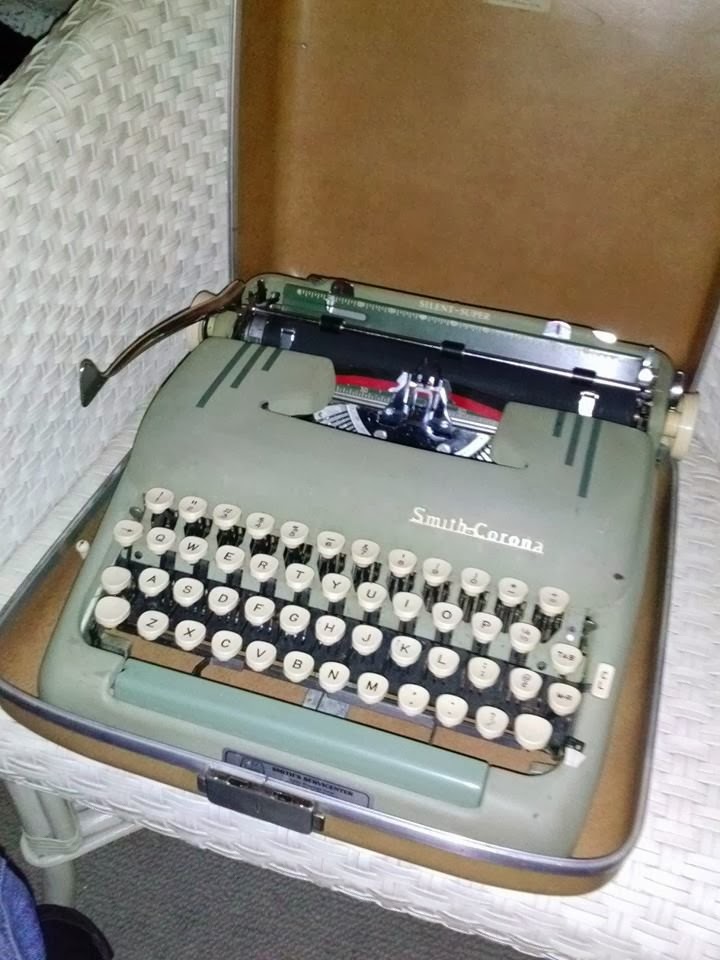
I tried the Smith-Corona typewriter again today when I decided to write my friend Sawyer a letter. Ze (hir preferred, androgynous pronouns are hir and ze) lives in Washington state, specifically forty minutes away from Seattle. The lines of ink coated a once blank sheet of paper. Because of the pressure needed, I had to backspace and hit the letters again, setting some of the words darker.
My father watched me from his chair, and Mom sat near him, sprawled out on the couch with chips in a bowl. Each time the bell went off, he smiled. She focused on the television. The Waltons were on, a show she never missed. The thwacks of hammers made her and the cat peek over.
It's an amazing experience being able to use a typewriter. Unlike laptops, which allow authors to vomit ideas out and fix later, typewriters require patience, perfection. One error means stopping, rolling away the lever, and blotting out letters with correction-fluid. Instead, I let the errors, however little there were, come out, and I told my friend how I am still getting used to it.
The errors, to me, are part of the magic. My parents found the machine in the garage, a mess with sticking keys and scratched parts. With it working and alive, breathing under my fingers, the errors feel right. Hemingway used a typewriter after he drafted in pencil and paper. Other authors, surely, tried their best to create the next masterpiece. When one uses a typewriter, the music of the bells and clicks are just a part of the meticulous work involved.
I plan to use the typewriter for letters and nonfiction pieces. The reality and age feels right with nonfiction, and using the typewriter, everything feels cultural. California is full of history, and maybe this is a way for me to experience classic California from the comfort of my living room or foyer. I am sure my friend, Sawyer, will be glad to find hir letter done in real, fresh pressed ink.
The smell of it on my hands, I am told, is pretty great, too.
We opened to find that his 60-year-old typewriter had returned from repairs, clean and polished, keys waiting to be pressed. The carbon receipt he was given sat against the roller.
"Type something," Dad said.
I tapped a key, but nothing showed from the light touch. I pressed on the I key, and a line of ink appeared after a silver hammer thwacked the ribbon.
Dad raised his arm and nodded.
My mind focused on the machine, and I forgot about the bowl of oats waiting for me. Letters became words, and at the end of the line, a bell went off. I slid the roller to the right until the bell rang again, and I typed more.
We finished and closed the lid. Dad loped to his chair in the dark, and I took my breakfast to my room.
I tried the Smith-Corona typewriter again today when I decided to write my friend Sawyer a letter. Ze (hir preferred, androgynous pronouns are hir and ze) lives in Washington state, specifically forty minutes away from Seattle. The lines of ink coated a once blank sheet of paper. Because of the pressure needed, I had to backspace and hit the letters again, setting some of the words darker.
My father watched me from his chair, and Mom sat near him, sprawled out on the couch with chips in a bowl. Each time the bell went off, he smiled. She focused on the television. The Waltons were on, a show she never missed. The thwacks of hammers made her and the cat peek over.
It's an amazing experience being able to use a typewriter. Unlike laptops, which allow authors to vomit ideas out and fix later, typewriters require patience, perfection. One error means stopping, rolling away the lever, and blotting out letters with correction-fluid. Instead, I let the errors, however little there were, come out, and I told my friend how I am still getting used to it.
The errors, to me, are part of the magic. My parents found the machine in the garage, a mess with sticking keys and scratched parts. With it working and alive, breathing under my fingers, the errors feel right. Hemingway used a typewriter after he drafted in pencil and paper. Other authors, surely, tried their best to create the next masterpiece. When one uses a typewriter, the music of the bells and clicks are just a part of the meticulous work involved.
I plan to use the typewriter for letters and nonfiction pieces. The reality and age feels right with nonfiction, and using the typewriter, everything feels cultural. California is full of history, and maybe this is a way for me to experience classic California from the comfort of my living room or foyer. I am sure my friend, Sawyer, will be glad to find hir letter done in real, fresh pressed ink.
The smell of it on my hands, I am told, is pretty great, too.
Sunday, March 2, 2014
Spring in Academia
It wasn't until I parked that I realized how much I had to rush. Cars lined the fences of Mt. San Antonio College. A breeze had picked up, and crowds hunkered around the crossing sign at the closest intersection, one parking lot away. For the start of a semester, this wasn't too bad.
My classes are mixed throughout the week: Mondays and Wednesdays are Speech, Tuesdays and Thursdays are Nonfiction, and Thursday nights are Career Development. I decided to take a lighter semester as I work in other classes, tutoring students and preparing them for their next courses. Nothing too hard, I said.
I'll be working forty hours a week, at least.
Crossing the street, I had to squeeze my way through trudging students. I then had to climb the hill. My phone said it was 8:35, which meant that I was later for an 8:30 meeting.
The American Language department wasn't too much of a walk from where I was. There, I would find my first work section, a linked or connect unit of two classes leading from 9:45 A.M. to 2:05 P.M.. A line led out the front doors. Students of various nationalities fidgeted, sighed, groaned. Those at the end of the line didn't seem any happier, speaking in broken English.
Eight minutes passed until I found the office of the professor I would be working under. The office hid at the end of the hall, but when I stepped in, the professor greeted me and pulled me to a chair. I was given a textbook, syllabus, and discussion of what to expect. Smiling, I agreed that this semester would be interesting, fun.
Class started on time, and I might another professor. She gave her name, office hours, and expectations. Halfway through, she introduced me. I stood in front of the class, eyes watching over me. Day one, and I knew that I was in for a ride.
My classes are mixed throughout the week: Mondays and Wednesdays are Speech, Tuesdays and Thursdays are Nonfiction, and Thursday nights are Career Development. I decided to take a lighter semester as I work in other classes, tutoring students and preparing them for their next courses. Nothing too hard, I said.
I'll be working forty hours a week, at least.
Crossing the street, I had to squeeze my way through trudging students. I then had to climb the hill. My phone said it was 8:35, which meant that I was later for an 8:30 meeting.
The American Language department wasn't too much of a walk from where I was. There, I would find my first work section, a linked or connect unit of two classes leading from 9:45 A.M. to 2:05 P.M.. A line led out the front doors. Students of various nationalities fidgeted, sighed, groaned. Those at the end of the line didn't seem any happier, speaking in broken English.
Eight minutes passed until I found the office of the professor I would be working under. The office hid at the end of the hall, but when I stepped in, the professor greeted me and pulled me to a chair. I was given a textbook, syllabus, and discussion of what to expect. Smiling, I agreed that this semester would be interesting, fun.
Class started on time, and I might another professor. She gave her name, office hours, and expectations. Halfway through, she introduced me. I stood in front of the class, eyes watching over me. Day one, and I knew that I was in for a ride.
Thursday, November 7, 2013
Nanowrimo and the Invasion of the Body Snatchers
On November 1st, precisely at twelve A.M. when everyone is to be asleep, select individuals are wiped clean of their existence. They are not the same person anymore; their name is a vague look back to the previous person who used to control the body. When they wake up, several hours later, they will get up, wash, and be changed forever.
It sounds like a thrilling Science Fiction film, but it's Nanowrimo, the latest craze to hit the literary world since hardcover books. Nanowrimo is an annual event where writers promise to finish fifty-thousand words of a working novel draft within a month, and each day is a contest to complete the much needed word count goal. It illustrates the ongoing challenges authors go through while expressing that anyone can write if they sit down, silence everything, and write.
But writing this much in a day is inhuman, alien even. Students, hobbyist, parents, and others take this challenge and become someone new. Their minds become driven to find the next plot point, the next story direction. Their fingers wriggle out in a flurry of typing. Even when away from a keyboard, the victim cannot control his or her hands as they wait to cling to a writing device. The host becomes, dare I say it, an author.
Nanowrimo is great because it sets a goal for these new authors. Its no weaker than a manuscript deadline an editor might give, nor is it weaker than one an author would put on himself alone. Individuals can finish fifteen-hundred words in an afternoon and say, hey, I'm really doing this.
Being an author is very difficult. While society might dictate that writing is simply play, it's not. We are paid little money, with little hope, to play the lottery with ourselves. Will this turn out as great as I thought? Who knows. Will I make it big? Why is this even a question? We writers write because we enjoy it, love it even. The rush of words coming from what feels like nowhere is cathartic, and we have to constantly fight ourselves for free time, something that is a luxury.
That's what Nanowrimo gives us: a helping hand. You must get through your first draft without looking back, you must write this within thirty days, and you must enjoy yourself. That's it. It will not make you an award-winning author, nor will it make you the next Stephenie Meyers. However, it will change you, make you into a new being that's determined, creative, inspired, and perhaps even a future author.
If you start talking about a spaceship or next big invasion, however, you're on your own.
It sounds like a thrilling Science Fiction film, but it's Nanowrimo, the latest craze to hit the literary world since hardcover books. Nanowrimo is an annual event where writers promise to finish fifty-thousand words of a working novel draft within a month, and each day is a contest to complete the much needed word count goal. It illustrates the ongoing challenges authors go through while expressing that anyone can write if they sit down, silence everything, and write.
But writing this much in a day is inhuman, alien even. Students, hobbyist, parents, and others take this challenge and become someone new. Their minds become driven to find the next plot point, the next story direction. Their fingers wriggle out in a flurry of typing. Even when away from a keyboard, the victim cannot control his or her hands as they wait to cling to a writing device. The host becomes, dare I say it, an author.
Nanowrimo is great because it sets a goal for these new authors. Its no weaker than a manuscript deadline an editor might give, nor is it weaker than one an author would put on himself alone. Individuals can finish fifteen-hundred words in an afternoon and say, hey, I'm really doing this.
Being an author is very difficult. While society might dictate that writing is simply play, it's not. We are paid little money, with little hope, to play the lottery with ourselves. Will this turn out as great as I thought? Who knows. Will I make it big? Why is this even a question? We writers write because we enjoy it, love it even. The rush of words coming from what feels like nowhere is cathartic, and we have to constantly fight ourselves for free time, something that is a luxury.
That's what Nanowrimo gives us: a helping hand. You must get through your first draft without looking back, you must write this within thirty days, and you must enjoy yourself. That's it. It will not make you an award-winning author, nor will it make you the next Stephenie Meyers. However, it will change you, make you into a new being that's determined, creative, inspired, and perhaps even a future author.
If you start talking about a spaceship or next big invasion, however, you're on your own.
Tuesday, October 1, 2013
Using Journalism as a Form of Character Creation
It's been a while since I last posted here. School is in session, and work has me making sure students are on their game most of the time. This leaves little room for me to write anything out of my Novel course's required chapters (the class being taught by John Brantingham himself).
When I'm free, however, I do find the time to draft short non-fiction pieces. I'm a huge fan of travel writing and watching a landscape come to life with just a few words. It's magic--the same magic which brought me into writing creatively. Even without traveling to my favorite city up north, I can at least describe it.
There's another purpose to being a fictional reporter. As a writer, I find myself constantly squabbling over how important it is to give a strong, detailed character illustrated by his or her actions. The mind can only see so much, so I have to put the character to work, just so everything becomes clear to the reader. In a recent, featured article in The Writer, Patrick Scalisi discusses how a writer can form stronger characters just by treating an exercise as if a professional, journalistic interview. It doesn't require the author to be a professional in journalism, as Scalisi argues, and it allows the writer to express any ideas while letting the character have his or her way.
Interested in non-fiction, I decided to give it a try with my latest character, Paul, a narcissistic cheater living two lives.. The interview piece is short, but I was able to see more so on the first layer of my character, Paul Greer, while understanding what he has to hide deep inside. Here's what came out:
When I'm free, however, I do find the time to draft short non-fiction pieces. I'm a huge fan of travel writing and watching a landscape come to life with just a few words. It's magic--the same magic which brought me into writing creatively. Even without traveling to my favorite city up north, I can at least describe it.
There's another purpose to being a fictional reporter. As a writer, I find myself constantly squabbling over how important it is to give a strong, detailed character illustrated by his or her actions. The mind can only see so much, so I have to put the character to work, just so everything becomes clear to the reader. In a recent, featured article in The Writer, Patrick Scalisi discusses how a writer can form stronger characters just by treating an exercise as if a professional, journalistic interview. It doesn't require the author to be a professional in journalism, as Scalisi argues, and it allows the writer to express any ideas while letting the character have his or her way.
Interested in non-fiction, I decided to give it a try with my latest character, Paul, a narcissistic cheater living two lives.. The interview piece is short, but I was able to see more so on the first layer of my character, Paul Greer, while understanding what he has to hide deep inside. Here's what came out:
The ferry roars into the docks and when
settled, its gates open to let out dripping tourists and locals, each
with cameras in their hands. Their ponchos glisten against the muted
background of San Francisco's bay, and I watch them peel the layers
away until they stand in jeans and sweaters.
One man stands in a polo-shirt and
pair of slacks. In his hand, he has a cell-phone and pair of bug-eyed
sunglasses.
Paul Greer works in Los Angeles as an
attorney and public speaker. For him, traveling up north is just
another day to add to his resume. We sit down on a bench in front of
the clock tower standing over Market Street, with sandwiches in our
hands, warm.
“My trips are usually centered on
wealthy businessmen, divorcing families, land owners.”
“Do you ever feel the drive's too
much?”
He smiles and I can see lettuce stuck
between his teeth. “It's worth it.”
For him, the cool winds overlap into
his burning world down south, where his family lives and works
without him. He brings them food, souvenirs, and portraits they
cannot get unless they spend the salary on traveling, something he
says is an arguable approach.
“My wife has a kid, and there's
another one on the way.”
“Does that upset you they'll be
growing up only seeing you half of the time?”
“We get used to it, and my son knows
a trip means toys, bread.” He takes another bite out of his
sandwich. “He's fond of those shaped bread loaves, from Boudin's.”
As we're talking, a group of students
rush to a halted street-car, the F-Line. The bell rings and the back
door opens. Passengers get out, and Paul watches. We wait for the
door to close and the tube of chrome to screech away.
“I never get used to this city. I
call it the city of love, and each drive up here is a new experience,
new dream.”
My sandwich begins to get cold as a
pelican waddles up, head turned and eyes watching me. “What does an
attorney dream of?”
He holds for a second when the bird
moves up, and his right foot lifts, scaring the pelican away.
“I've asked the same thing with the
Boogeyman, and I still haven't found an answer. I go where the money
is.”
“And is the money always in San
Francisco?”
He nods his head, bites the steaming
pastrami once more, and doesn't wait to speak. “Sometimes,” he
says. “Sometimes.”
John Brantingham is an author teaching in Southern California. His work can be found at johnbrantingham.blogspot.com.
The Writer is a monthly publication, which can be found online at Writermag.com.
"Character Profile," written by Patrick Scalisi, can be found here, http://www.writermag.com/2013/09/30/character-profile/
Tuesday, August 27, 2013
Things That are Warm in the Night
My twin-brother
opened my door and told me that there was something wrong. He looked
surprised, and even if it did jolt me, I took a second before turning
my chair to look at him. He was dressed, and the light from his room
glistened in the hallway's mirror.
I asked him what was wrong, and he told
me that something turned the fan on. Both him and his girlfriend were
in bed, napping, and it just turned on without anyone pressing the
button. It was his girlfriend who woke up first, then she turned over
and shook him awake to see.
Electricity can do that, though. If the
device is used repeatedly after some time of service, energy can move
through and power the device without having to be turned on. Think of
it like a congested highway tunnel emptied of the rush hour crowd,
ready to be used by locals.
I did think of the times I felt someone
in my room, however. Also, after returning from a trip to the gym, I
found my pair of dumbbells stacked on top of each other, waiting for
me on my desk chair. My blankets have even been pulled from me one
night, too, but that's just what it felt like. It could've been me
kicking them down.
So I didn't say anything, and I just
listened. When he was finished, I let him know to tell me if it
happened again. The fan would turn on one more time before they left
to his girlfriend's home, startled.
It's always best to be a skeptic when
anything supposedly paranormal occurs, whether at home or not. The
fact that something as such happened is interesting, but nothing too
much to raise an eyebrow for. Years of being a paranormal junkie have
desensitized me to the littlest things, such as when I went to a
haunted tour in San Francisco, and when the tour guide said we
might've caught orbs, I simple shrugged and said, "it could be
dust."
He wasn't too happy that others grew
discouraged.
I've gone into my brother's room to see
if the fan will turn on for me. It hasn't yet, but when he's gone and
the Xbox is open for me to play, I'll go in and sit for a while, with
Minecraft on the screen, waiting to see if the fan will turn on
without one press of its controls.
Thursday, June 27, 2013
Handling Rejection: Advice for the New Writer
When I first started writing, rejection was a weight in my stomach that never went away. Even today, it's still there, and with each story I send out, the weight grows stronger. But that's not what writing's about, I tell myself.
Yes, rejection is a natural part of the writing process. Some stories work with some magazines, and other stories need to be placed somewhere else--that's how the business works. However, we write because we have a story to tell, something that someone out there must know. For myself, it's the common struggle that minorities face every day as they work towards equality or a higher form of understanding. To others, it might be an action filled, horrifying tale of what happened during vacation. Now, in what part of these is there rejection?
It's crazy, but being a writer is all about, you guessed it, writing. Publishing is only a gold coin that adds flavor to our passion, so if one magazine doesn't accept our story, we can look at the story for what it is, maybe revise it a bit more, then move to the next magazine and see where it goes--that's it.
Writers carry such a burden with rejection, however, because it's their work--their children. To see our offspring be rejected is hard, and it does hurt. Writers need to remember, however, they are not being rejected as a person.
In Catch! A Fishmongers Guide to Greatness, Cyndi Crother and the World Famous Pike Place Fish crew discuss that when working, they carry a short motto that allows them to remember everything's not as bad as it seems. Their phrase is "it's all over here," meaning that whatever negative ideas that are thought are not from others, but from ourselves (16). When I first started writing, I felt that I would never get published. At the time, I felt that in order to be a writer, I needed to be published. Writing stories became difficult because I would want them perfect, and the pieces eventually just ended up in my laptop's recycle bin. However, once I let go that editors and publishers were out to destroy my work and mood, writing and submitting became easier.
And that's the most important thing: submitting and being rejected is easy. When someone asks if we would like a glass of water, and we say no, the other person hopefully is not hurt by our rejection. The same thing applies here, but editors feel that our work is not fit for their magazine. Well, what do we do after a rejection, then?
Send to another magazine and keep writing.
It takes courage to continue to send out stories, poems, and novels with the idea rejection could be there, but rejection is not a way to destroy us. Publishers and editors want our stories; they want someone to hear what we have to say. As writers, our job is to enjoy our passion and see who else possibly would like to tell our story.
It's been a year since my first story was accepted, and for twelve months I received a large amount of rejections. Instead of letting them burden me, I printed the first rejection I received and posted it on the wall, telling myself that it's just a piece of paper ("It's all over here"). As authors, our job is to tell a story, and someone out there wants to hear it. It might take time to find that person, but when we do find them, it's the best feeling ever.
Until then, we just keep writing.
Friday, June 7, 2013
Writing Tutoring and the Future
As a writing tutor, I get an experience of both being a student and a teacher. It's an odd mix as I have never thought of myself as a teacher, but I've been told by students that's how we--meaning tutors--are seen as. That's not the reason I tutor, however. For me, tutoring is a way to keep myself busy and talking and thinking about writing. Some would argue that's like doing homework every day, but I find it play-time.
This semester was different for me as I actually had a professor mentor over me while I tutored in her classroom. It was a new form of work I have never been given, and it brought many challenges along the way. But I ultimately learned a lot, such as how to handle the different types of learners further, how much planning goes into a lesson, how flexible a professor/instructor must be with the tasks at hand and how the students digest it, and how many ways writing can be looked at. Not only did this help me as a tutor, but this affected me in my writing.
The structures and tones I witnessed opened my eyes, and the stories some students told me gave me a further glance into human nature and the conflicts that can occur. One student, an older woman, told me large stories of her day-to-day concerns and accomplishments; then she proceeded to discuss how if something happens on a small scale, it can affect her and the day in its entirety. Story wise, this gave me the opportunity to apply ideas on character direction in impossible, stressful situations. Even in non-stressful situation, a character could react horribly, putting them into a new conflict (though, the student I speak of never did such a thing, I must add). The position didn't just affect my fiction, but it changed how I viewed my own future and direction.
Two years ago, I would have never thought of becoming a professor in anything, but I fin myself thinking towards the idea every day. Being payed to help others and push them to a new level with writing, something I'm passionate for, sounds amazing even there are those who are obviously less passionate. Furthermore, my own studies have revealed that I'm heavily interested in focusing on female literature and feminist arguments even more so than I had thought before. I plan to see a counselor next week and announce my major in English, so I'm excited, but as the semester wraps up, My plan is to dive heavily in fiction.
As a student, it's difficult to find free time that works with class, work, and fiction writing. The same can be argued for anything: being a professor, parent, business-person, police-officer, etc. But these next few months will allow me to tackle my writing skills at the same level I had previously, and I will be able to read as many books as I want to assist. The students laughed when I stated I would be writing all summer, but they didn't realize how much this is a passion for me. That, or maybe my thriller stories are really starting to affect me.
This semester was different for me as I actually had a professor mentor over me while I tutored in her classroom. It was a new form of work I have never been given, and it brought many challenges along the way. But I ultimately learned a lot, such as how to handle the different types of learners further, how much planning goes into a lesson, how flexible a professor/instructor must be with the tasks at hand and how the students digest it, and how many ways writing can be looked at. Not only did this help me as a tutor, but this affected me in my writing.
The structures and tones I witnessed opened my eyes, and the stories some students told me gave me a further glance into human nature and the conflicts that can occur. One student, an older woman, told me large stories of her day-to-day concerns and accomplishments; then she proceeded to discuss how if something happens on a small scale, it can affect her and the day in its entirety. Story wise, this gave me the opportunity to apply ideas on character direction in impossible, stressful situations. Even in non-stressful situation, a character could react horribly, putting them into a new conflict (though, the student I speak of never did such a thing, I must add). The position didn't just affect my fiction, but it changed how I viewed my own future and direction.
Two years ago, I would have never thought of becoming a professor in anything, but I fin myself thinking towards the idea every day. Being payed to help others and push them to a new level with writing, something I'm passionate for, sounds amazing even there are those who are obviously less passionate. Furthermore, my own studies have revealed that I'm heavily interested in focusing on female literature and feminist arguments even more so than I had thought before. I plan to see a counselor next week and announce my major in English, so I'm excited, but as the semester wraps up, My plan is to dive heavily in fiction.
As a student, it's difficult to find free time that works with class, work, and fiction writing. The same can be argued for anything: being a professor, parent, business-person, police-officer, etc. But these next few months will allow me to tackle my writing skills at the same level I had previously, and I will be able to read as many books as I want to assist. The students laughed when I stated I would be writing all summer, but they didn't realize how much this is a passion for me. That, or maybe my thriller stories are really starting to affect me.
Monday, March 25, 2013
TC-Class: Parasitic Plagiarism and You
The art of plagiarism is one many
students find themselves running into, sucking the life out of their work and creating chaos. It is a tricky
subject, plagiarism is, in that the idea of stealing someone's exact
words, phrases, and ideas brings up quarrelsome thoughts to some writers: they are
just words and expressions. This is where most incoming students get
nailed, and they land on the receiving end of a failing grade, perhaps even
expulsion.
But to plagiarize something is
actually quite tricky; to take someone's own words and try to pull
them off takes some time to perfect, and, realistically,
it is a wasted effort in the fact that he or she gets nothing out of it. No, in college, where ideas are to be expressed in an open, mature manner, it is
much simpler, and fun, for the writer to create their own masterpiece of
communication and spread it about the campus, possibly attached with
a well deserved A.
To refrain from plagiarism, it is best
for the student to understand that everything a published writer brings to a
work is by ownership his or her own: words, syntax (the way the words are pieced
together), ideas (arguments, stories, logical connections, etc.); and
if the work is of fiction, the student writer must remember to attach
each bit of dialogue and plot structure into attribution, or giving
credit back to the original author (“In the short story 'Apology
Accepted,' John J. Lewis illustrates...”).
MLA, or the Modern Language
Association, is a swell group that provides structure and orderliness
to the act of attributing a work; their handbooks direct student
writers to introduce an author at the start, and follow up by mentioning him or her after each quotation
or idea in parenthetical citations (along with a nifty page or
paragraph number). When asked not to directly quote though,
paraphrasing becomes a tricky obstacle.
Paraphrasing can be difficult, but
remember: it is telling the idea in your own words, still giving all
credit back to the author. Located on their website, Purdue OWL
states, "Paraphrasing is one way to use a
text in your own writing without directly quoting source material. Anytime you are taking information from a source that is not your
own, you need to specify where you got that information." Paraphrasing and quotations should be used as needed in order to respectfully attribute back to an author, but every original idea regarding a subject must come from the student. Look at it that the
author still needs a reason to get payed for his or her work, and
while you might not be payed, you are taking that away from him or her.
As a student, the average college writer is stepping
away from high school and onto bigger, better, less dramatic things,
but that means giving credit where credit is due just as a
professor would give a high passing grade for the work that student has
completed on their own.
Plagiarism is a parasitic pest; once a
student begins to commit it, it will continue to grow in that
student, and fester, until finally he or she is caught and removed
like a tick, marked forever as a thief of logic. That is not to say
that writing strong and logical, original ideas is difficult; rather, it
is much easier in that the student writer is creating, bringing life into a
piece that no one else has seen before. It is rewarding to see the
polished work--the writer's own work--return without someone else
stealing the vibes. Any college student, experienced or not, can
argue the same.
Purdue OWL on Quoting, Paraphrasing, and Summarizing can be found here:
http://owl.english.purdue.edu/owl/resource/563/01/
---Plagiarism:
http://owl.english.purdue.edu/owl/resource/589/01/
Purdue OWL on Quoting, Paraphrasing, and Summarizing can be found here:
http://owl.english.purdue.edu/owl/resource/563/01/
---Plagiarism:
http://owl.english.purdue.edu/owl/resource/589/01/
Thursday, March 14, 2013
Writing from the Prompt
In college, one of the most important things when it comes to writing is being able to follow directions correctly by understanding what's asked. If a professor states they want a four page minimum and several sources prevalent throughout the piece, then it's best to give them what they ask for; however, essays and summaries are not the only forms of writing that can be prompted.
I visited the classroom of John Brantingham after work to visit the Creative-Writing Club, a group of writers I haven't worked with before. He wasn't there, taking some time off to recover, but the club was hosted by the president and other coordinators. Walking in late, I slipped into the back, but I found myself added to the activities of introducing ones self and, of course, writing under a timed, prompt restrained setting. We were asked to write creatively, though: fiction and poetry was up for grabs, and I decided on doing the fiction. For the short-story, we had a few restraints written on the board:
"Can you tell me why he's following you?" David wiped the sweat off his brow, staring out the bungalow's front window.
Amy held herself from an unseen breeze. "I'm not sure, but he's everywhere."
"He can't be everywhere."
"Yes, he can," she said.
David turned. The golden giraffe pin, something only given to experienced handlers throughout the year--from what he said--glinted in the young woman's eyes, burning her. It illuminated her split ends into hanging embers of ash.
"Listen, Amy, you're just tired. You've been working too much."
She sighed. "And what are you saying?"
"No one's chasing you out there, is what I mean; no one's hunting you."
"You don't know. You don't know what I've been through," she said. "The freak watches me sleep. And that makeup."
David turned to the window once more, palm on the glass with the other hand up.
"His makeup looks like he buck-fumbled through it."
"Does it frighten you?" he asked.
Amy opened her lips, glancing at the handler. She wanted to tell him yes. She wanted to say how she wished David would hold her, letting her cry in his arms, taking away the weeks of hiding in the restroom and tidying a knife beneath her pillow. But, when he turned, her eyes clenched at the reflection of his dulled, misshapen clown nose.
It isn't much, but it gave me a chance to just let a story come out, and allow the characters to breathe and become their own entities. Working with this novel, The Neptune, has pulled me from that very idea; I feel as though I need to plot so heavily, when I should let the work write itself instead.
For Mt. Sac students, the club is on Thursdays, 2:30 to 4:00 P.M. and is hosted in 3411 of 26A. I'm personally looking forward to returning. Stop by if you want to give writing a chance!
I visited the classroom of John Brantingham after work to visit the Creative-Writing Club, a group of writers I haven't worked with before. He wasn't there, taking some time off to recover, but the club was hosted by the president and other coordinators. Walking in late, I slipped into the back, but I found myself added to the activities of introducing ones self and, of course, writing under a timed, prompt restrained setting. We were asked to write creatively, though: fiction and poetry was up for grabs, and I decided on doing the fiction. For the short-story, we had a few restraints written on the board:
- The Protagonist's name was Amy.
- Amy worked in a clown store.
- She was deeply in love with a giraffe handler.
- Amy had an evil clown stalker.
- We must use the word "Buck-fumbling" within the literature.
"Can you tell me why he's following you?" David wiped the sweat off his brow, staring out the bungalow's front window.
Amy held herself from an unseen breeze. "I'm not sure, but he's everywhere."
"He can't be everywhere."
"Yes, he can," she said.
David turned. The golden giraffe pin, something only given to experienced handlers throughout the year--from what he said--glinted in the young woman's eyes, burning her. It illuminated her split ends into hanging embers of ash.
"Listen, Amy, you're just tired. You've been working too much."
She sighed. "And what are you saying?"
"No one's chasing you out there, is what I mean; no one's hunting you."
"You don't know. You don't know what I've been through," she said. "The freak watches me sleep. And that makeup."
David turned to the window once more, palm on the glass with the other hand up.
"His makeup looks like he buck-fumbled through it."
"Does it frighten you?" he asked.
Amy opened her lips, glancing at the handler. She wanted to tell him yes. She wanted to say how she wished David would hold her, letting her cry in his arms, taking away the weeks of hiding in the restroom and tidying a knife beneath her pillow. But, when he turned, her eyes clenched at the reflection of his dulled, misshapen clown nose.
It isn't much, but it gave me a chance to just let a story come out, and allow the characters to breathe and become their own entities. Working with this novel, The Neptune, has pulled me from that very idea; I feel as though I need to plot so heavily, when I should let the work write itself instead.
For Mt. Sac students, the club is on Thursdays, 2:30 to 4:00 P.M. and is hosted in 3411 of 26A. I'm personally looking forward to returning. Stop by if you want to give writing a chance!
Wednesday, February 6, 2013
Friendly Communication: Body, Voice, and Mind
Communication is an important part of living. Especially as a writer, too. You're going to meet lots of new, and possibly intimidating, people, and whether you're a writer or not, it's best to approach someone in a certain way. Looking at animals, body language is very detrimental to communication; when a dog's in fight-or-flight mode it's teeth are bared, and its hackles are raised. The same thing works with humans. We might not snarl, or raise our necks when angry--scary image, I know--so the question is how do we use our language, spoken and physical, to send a clear message to a peer or co-worker?
At work, I meet with a lot of students from many different backgrounds. Some are native speakers, and it's easier to communicate, while others can be transfer students from different levels of education--or even different cultures! I try to keep myself open to whatever comes, and keep myself open and friendly.
Being open and friendly doesn't just mean keeping a smile glued on. It means carrying a certain composure. If I were to walk up to another writer, published or not, things would go much smoother in introductions if I were standing straight, keeping eye contact, and my hands arms were visible at all times; furthermore, if I was to greet them screaming, arms crossed, and possibly one hand behind my back, I could be taken as a threat. Of course it's an exaggeration, but it works.
When I meet the student, no matter what background, I greet them with my name, a soft, friendly tone, and arms out and seen. I make eye contact, but don't stare into them to find the inner-direction of their soul's desires. Tutoring, I sit down, turned slightly towards them, and I'm a foot away as to not hover on them. If standing, I would be at an angle, as well; sitting or standing directly in front of a person can be seen as off-putting and tense. I don't cross my arms, and if I get comfortable in my chair, I might sit in a relaxed way. Standing comfortably, if that were the situation, you would loosen up and not be so tense.
To give an example, police-officers crouch low to speak with a child when they're hurt, upset, scared, or just conversing. This puts the officer at level with the child and takes away the image of someone stern and intimidating. Another would be when someone's dealing with an angered person; people can be upset for many reasons, such as the child, but speaking with open posture and gestures, and a soft tone (not too soft, though. You don't want to come off as condescending), the situation could be lowered into an understanding discussion of the situation.
I was tutoring a student today, and with her final draft due the following week, she was stressed for perfection. It's common to see these situations. It's even more common to see it when the paper is due the next day, so I came into the session letting her know we had time to work on it. I kept my tone soft, and I pulled myself away from the tutoring sheet and red pen (I would go back to take notes, but a red pen is something we all know as a horrible thing inflicted on us in grade school, so space worked out there). The situation was lowered, but she was stressed that her examples in the paper spoke on their own, not needing discussion to explain. I grew comfortable, so I lifted my legs onto the chair, sitting on my thigh.
"With essays," I started, "the reader's coming in for information."
She didn't look at me, but she stared at her essay.
"In fiction, the reader works to use their imagination and put themselves in the story. Here, however, we want to do the opposite and show the readers step by step how this example relates to everything."
"But it should stand on its own," she said.
I discussed it further with some examples, and she had a better understanding. The situation would have been much more stressful if I raised my tone and did something as simple as turned away, or crossed my arms.
Having open body language and a friendly outflow of discussion creates positive socialization. The use of negative tone, raised volume, or acting intense, direct, and even mean can have repercussions whether in simple speech or professional settings. This works with writing as well, but without the use of body-language; the tone and direction you take in communication is what your audience will use to assess the situation. Whether you're working on campus with just-as-stressed students, or at home with your parents, communicating in a outflow of positive vibes can make even the most direct and negative situations into something approachable.
At work, I meet with a lot of students from many different backgrounds. Some are native speakers, and it's easier to communicate, while others can be transfer students from different levels of education--or even different cultures! I try to keep myself open to whatever comes, and keep myself open and friendly.
Being open and friendly doesn't just mean keeping a smile glued on. It means carrying a certain composure. If I were to walk up to another writer, published or not, things would go much smoother in introductions if I were standing straight, keeping eye contact, and my hands arms were visible at all times; furthermore, if I was to greet them screaming, arms crossed, and possibly one hand behind my back, I could be taken as a threat. Of course it's an exaggeration, but it works.
When I meet the student, no matter what background, I greet them with my name, a soft, friendly tone, and arms out and seen. I make eye contact, but don't stare into them to find the inner-direction of their soul's desires. Tutoring, I sit down, turned slightly towards them, and I'm a foot away as to not hover on them. If standing, I would be at an angle, as well; sitting or standing directly in front of a person can be seen as off-putting and tense. I don't cross my arms, and if I get comfortable in my chair, I might sit in a relaxed way. Standing comfortably, if that were the situation, you would loosen up and not be so tense.
To give an example, police-officers crouch low to speak with a child when they're hurt, upset, scared, or just conversing. This puts the officer at level with the child and takes away the image of someone stern and intimidating. Another would be when someone's dealing with an angered person; people can be upset for many reasons, such as the child, but speaking with open posture and gestures, and a soft tone (not too soft, though. You don't want to come off as condescending), the situation could be lowered into an understanding discussion of the situation.
I was tutoring a student today, and with her final draft due the following week, she was stressed for perfection. It's common to see these situations. It's even more common to see it when the paper is due the next day, so I came into the session letting her know we had time to work on it. I kept my tone soft, and I pulled myself away from the tutoring sheet and red pen (I would go back to take notes, but a red pen is something we all know as a horrible thing inflicted on us in grade school, so space worked out there). The situation was lowered, but she was stressed that her examples in the paper spoke on their own, not needing discussion to explain. I grew comfortable, so I lifted my legs onto the chair, sitting on my thigh.
"With essays," I started, "the reader's coming in for information."
She didn't look at me, but she stared at her essay.
"In fiction, the reader works to use their imagination and put themselves in the story. Here, however, we want to do the opposite and show the readers step by step how this example relates to everything."
"But it should stand on its own," she said.
I discussed it further with some examples, and she had a better understanding. The situation would have been much more stressful if I raised my tone and did something as simple as turned away, or crossed my arms.
Having open body language and a friendly outflow of discussion creates positive socialization. The use of negative tone, raised volume, or acting intense, direct, and even mean can have repercussions whether in simple speech or professional settings. This works with writing as well, but without the use of body-language; the tone and direction you take in communication is what your audience will use to assess the situation. Whether you're working on campus with just-as-stressed students, or at home with your parents, communicating in a outflow of positive vibes can make even the most direct and negative situations into something approachable.
Monday, December 3, 2012
Finals--Chaos And a Word-processor
Working in the Writing-Center, it's a lie to say we don't notice the holiday chaos. The computer lab has been at, if not completely, near full capacity; the tables, reserved for one-on-one tutoring, are filled with papers, laptops, and every type of pen and pencil, making the center look as though there was a massive printing deadline at the Campus's Journalism department, but it's not the Journalism department--it's the entire school It's the end of the Fall semester at my community-college, and students are hunkering down, cogs spinning, working towards the end with a final push for the questionably well deserved A+.
As another student, I make sure I wake up with enough time to shave and make myself presentable, record and go over the day's plan, review any writing or revision notes I have for stories, and ultimately scarf down a boiling bowl of burnt oatmeal before the clock hits 8:05 A.M..
The drive is pleasant, and my twin-brother, manning the radio, makes sure there's enough music to keep it interesting. Parking isn't an issue anymore; at the beginning of the semester, the lot, and street, would be filled at 8 A.M.. Once I get to school and set into the greatest parking spot in the world, and situated for work at the center, I have no idea what goes on outside the doors.
Today, It took me until after my first shift to remember that I had a math final this upcoming Monday and I would need my shift covered; it took me until my final shift to remember I even had a twin-brother. The constant barrage of students, each with their reasons why the paper's due tomorrow, and they are barely drafting a thesis, boggles the mind, and forces us tutors to keep quick and adaptable. We're kind, understanding, nurturing people, and if we weren't then by God we shouldn't be tutoring. It's not just the students, however, caught in this mad frenzy, but we too are affected by this rush.
Some of us could be on our breaks, or in-between shifts, crumpled away in the break-room, studying or reworking a thesis paper. Others of us dash to the computer-lab on these off times before a computer could be swiped--respectfully, of course--hurrying to type up the next essay, story submission, and lab-report. The winter mindset has befallen us all, and turned the population of college students into ravenous creatures.
By the time I return home, I'm dead tired, and forced to scribe out around 50 equations of Algebra before I can write. When I hit the word-processor, nothing comes out but dull ideas, unoriginal plots, and dialogue that could make the writer's of the recent Twilight films into Shakespearian poets; tutoring, let alone School, is a mind-numbing, creativity-sucking time of the year. With the holiday season in swing, it's just two more weeks and we'll be home safe and free. The idea of presents, Christmas lights, cookies, and emasculating drinks at Starbucks just thrills the inner young-adult inside me.
Whatever your profession be--tutor, teacher, professor, writer, student, parent--good luck and enjoy your holidays; be grateful for what you have, the time spent together with friends, and the hard work you put towards your passions and studies.
But don't even get me started on Winter Intercession.
As another student, I make sure I wake up with enough time to shave and make myself presentable, record and go over the day's plan, review any writing or revision notes I have for stories, and ultimately scarf down a boiling bowl of burnt oatmeal before the clock hits 8:05 A.M..
The drive is pleasant, and my twin-brother, manning the radio, makes sure there's enough music to keep it interesting. Parking isn't an issue anymore; at the beginning of the semester, the lot, and street, would be filled at 8 A.M.. Once I get to school and set into the greatest parking spot in the world, and situated for work at the center, I have no idea what goes on outside the doors.
Today, It took me until after my first shift to remember that I had a math final this upcoming Monday and I would need my shift covered; it took me until my final shift to remember I even had a twin-brother. The constant barrage of students, each with their reasons why the paper's due tomorrow, and they are barely drafting a thesis, boggles the mind, and forces us tutors to keep quick and adaptable. We're kind, understanding, nurturing people, and if we weren't then by God we shouldn't be tutoring. It's not just the students, however, caught in this mad frenzy, but we too are affected by this rush.
Some of us could be on our breaks, or in-between shifts, crumpled away in the break-room, studying or reworking a thesis paper. Others of us dash to the computer-lab on these off times before a computer could be swiped--respectfully, of course--hurrying to type up the next essay, story submission, and lab-report. The winter mindset has befallen us all, and turned the population of college students into ravenous creatures.
By the time I return home, I'm dead tired, and forced to scribe out around 50 equations of Algebra before I can write. When I hit the word-processor, nothing comes out but dull ideas, unoriginal plots, and dialogue that could make the writer's of the recent Twilight films into Shakespearian poets; tutoring, let alone School, is a mind-numbing, creativity-sucking time of the year. With the holiday season in swing, it's just two more weeks and we'll be home safe and free. The idea of presents, Christmas lights, cookies, and emasculating drinks at Starbucks just thrills the inner young-adult inside me.
Whatever your profession be--tutor, teacher, professor, writer, student, parent--good luck and enjoy your holidays; be grateful for what you have, the time spent together with friends, and the hard work you put towards your passions and studies.
But don't even get me started on Winter Intercession.
Subscribe to:
Posts (Atom)