

I stand outside with my group of three peers, and we have less than five
minutes to make something up. Reading the textbook, I ask my group
what success made them think of. Sports, one says, so we talk about
fighting and basketball. How do we visualize success, I ask. We stand
under the buzzing light of a neighboring portable, thinking about it.
On Thursday nights, I attend a three hour course on developing career
and life directions. We've been discussing what colleges have been
looking for, but public speaking came up this past Thursday, when
we were told we would need to perform a short, two-minute skit in front of the
class.
Public speaking is the number one fear in the world, not spiders or HIV. On a daily basis, we put ourselves into situations that require us to speak publicly, yet our bodies begin to break into shakes and sweating when we're told suddenly to perform.
As writers, we don't feel the necessity to speak aloud to crowds of
people; our work is solitary. But that's not the truth, for writers are
those who sell their books. Writers go to conferences to meet
publishers, other writers, and working editors. Your publishers, I
argue, do shit of that. We are put on the front lines.
The professor assigned topics on what builds self-esteem. The professor put us outside in the dark lighting of a parking lot at eight, P.M.. He gave one group determination, another persistence. We got visualizing success.
Visualization, thankfully, can be used in multiple situations such as speaking publicly and writing. It helps move us forward in our writing. We all start with one word, Stephen King says. One word leads to a sentence, which creates a paragraph after a while. By visualizing this or performing well in front of a crowd, we feel the difficulty of our crafts drop and our confidence rise.
We're the last group to walk in when the professor presses the door open with his foot. As group one, we go first. We're standing at the front of the class, looking towards football players, adult students, coaches, and a champion softball player. Say your names, the professor says. I say mine first, and we move down the line. One breath. I think about the next, first word, and we start.
Two minutes become five minutes, and our class looks at us with open jaws. One group gets up and leaves the room.
Subscribe!

 Posts
All Comments
Posts
All Comments
Saturday, March 22, 2014

Sunday, March 9, 2014
Stepping into the Past: Using Typewriters in 2014
My father stopped me from pouring orange-juice into a mason jar. Oatmeal still in the microwave, I set the glass and carton down to see what he wanted. He asked me to lift an orange suitcase. I did, and we set it on the counter near my glass.
We opened to find that his 60-year-old typewriter had returned from repairs, clean and polished, keys waiting to be pressed. The carbon receipt he was given sat against the roller.
"Type something," Dad said.
I tapped a key, but nothing showed from the light touch. I pressed on the I key, and a line of ink appeared after a silver hammer thwacked the ribbon.
Dad raised his arm and nodded.
My mind focused on the machine, and I forgot about the bowl of oats waiting for me. Letters became words, and at the end of the line, a bell went off. I slid the roller to the right until the bell rang again, and I typed more.
We finished and closed the lid. Dad loped to his chair in the dark, and I took my breakfast to my room.
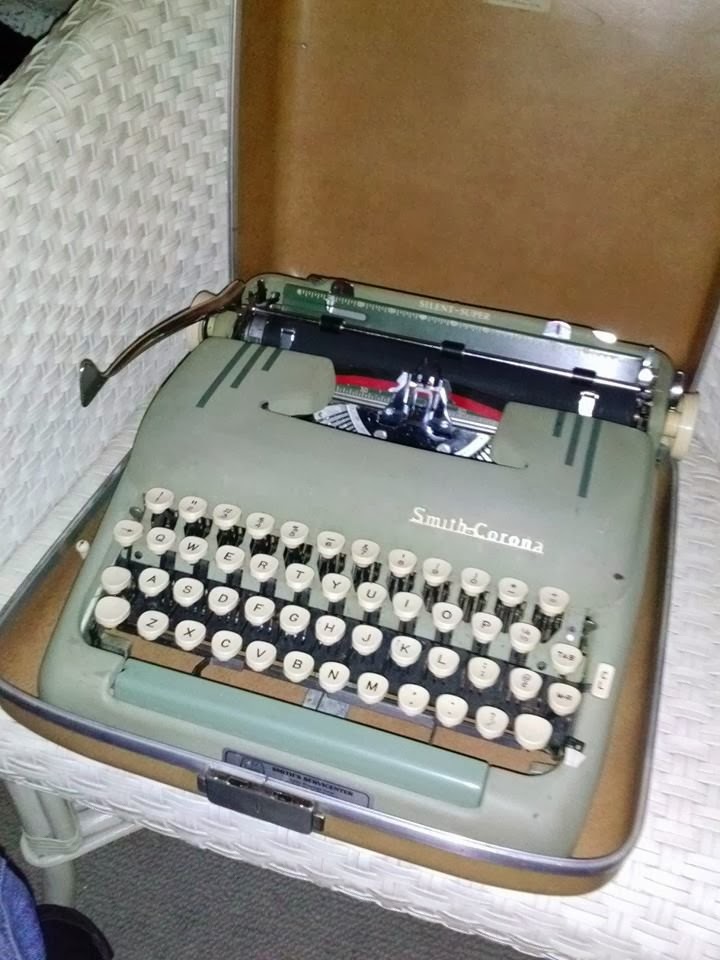
I tried the Smith-Corona typewriter again today when I decided to write my friend Sawyer a letter. Ze (hir preferred, androgynous pronouns are hir and ze) lives in Washington state, specifically forty minutes away from Seattle. The lines of ink coated a once blank sheet of paper. Because of the pressure needed, I had to backspace and hit the letters again, setting some of the words darker.
My father watched me from his chair, and Mom sat near him, sprawled out on the couch with chips in a bowl. Each time the bell went off, he smiled. She focused on the television. The Waltons were on, a show she never missed. The thwacks of hammers made her and the cat peek over.
It's an amazing experience being able to use a typewriter. Unlike laptops, which allow authors to vomit ideas out and fix later, typewriters require patience, perfection. One error means stopping, rolling away the lever, and blotting out letters with correction-fluid. Instead, I let the errors, however little there were, come out, and I told my friend how I am still getting used to it.
The errors, to me, are part of the magic. My parents found the machine in the garage, a mess with sticking keys and scratched parts. With it working and alive, breathing under my fingers, the errors feel right. Hemingway used a typewriter after he drafted in pencil and paper. Other authors, surely, tried their best to create the next masterpiece. When one uses a typewriter, the music of the bells and clicks are just a part of the meticulous work involved.
I plan to use the typewriter for letters and nonfiction pieces. The reality and age feels right with nonfiction, and using the typewriter, everything feels cultural. California is full of history, and maybe this is a way for me to experience classic California from the comfort of my living room or foyer. I am sure my friend, Sawyer, will be glad to find hir letter done in real, fresh pressed ink.
The smell of it on my hands, I am told, is pretty great, too.
We opened to find that his 60-year-old typewriter had returned from repairs, clean and polished, keys waiting to be pressed. The carbon receipt he was given sat against the roller.
"Type something," Dad said.
I tapped a key, but nothing showed from the light touch. I pressed on the I key, and a line of ink appeared after a silver hammer thwacked the ribbon.
Dad raised his arm and nodded.
My mind focused on the machine, and I forgot about the bowl of oats waiting for me. Letters became words, and at the end of the line, a bell went off. I slid the roller to the right until the bell rang again, and I typed more.
We finished and closed the lid. Dad loped to his chair in the dark, and I took my breakfast to my room.
I tried the Smith-Corona typewriter again today when I decided to write my friend Sawyer a letter. Ze (hir preferred, androgynous pronouns are hir and ze) lives in Washington state, specifically forty minutes away from Seattle. The lines of ink coated a once blank sheet of paper. Because of the pressure needed, I had to backspace and hit the letters again, setting some of the words darker.
My father watched me from his chair, and Mom sat near him, sprawled out on the couch with chips in a bowl. Each time the bell went off, he smiled. She focused on the television. The Waltons were on, a show she never missed. The thwacks of hammers made her and the cat peek over.
It's an amazing experience being able to use a typewriter. Unlike laptops, which allow authors to vomit ideas out and fix later, typewriters require patience, perfection. One error means stopping, rolling away the lever, and blotting out letters with correction-fluid. Instead, I let the errors, however little there were, come out, and I told my friend how I am still getting used to it.
The errors, to me, are part of the magic. My parents found the machine in the garage, a mess with sticking keys and scratched parts. With it working and alive, breathing under my fingers, the errors feel right. Hemingway used a typewriter after he drafted in pencil and paper. Other authors, surely, tried their best to create the next masterpiece. When one uses a typewriter, the music of the bells and clicks are just a part of the meticulous work involved.
I plan to use the typewriter for letters and nonfiction pieces. The reality and age feels right with nonfiction, and using the typewriter, everything feels cultural. California is full of history, and maybe this is a way for me to experience classic California from the comfort of my living room or foyer. I am sure my friend, Sawyer, will be glad to find hir letter done in real, fresh pressed ink.
The smell of it on my hands, I am told, is pretty great, too.
Sunday, March 2, 2014
Spring in Academia
It wasn't until I parked that I realized how much I had to rush. Cars lined the fences of Mt. San Antonio College. A breeze had picked up, and crowds hunkered around the crossing sign at the closest intersection, one parking lot away. For the start of a semester, this wasn't too bad.
My classes are mixed throughout the week: Mondays and Wednesdays are Speech, Tuesdays and Thursdays are Nonfiction, and Thursday nights are Career Development. I decided to take a lighter semester as I work in other classes, tutoring students and preparing them for their next courses. Nothing too hard, I said.
I'll be working forty hours a week, at least.
Crossing the street, I had to squeeze my way through trudging students. I then had to climb the hill. My phone said it was 8:35, which meant that I was later for an 8:30 meeting.
The American Language department wasn't too much of a walk from where I was. There, I would find my first work section, a linked or connect unit of two classes leading from 9:45 A.M. to 2:05 P.M.. A line led out the front doors. Students of various nationalities fidgeted, sighed, groaned. Those at the end of the line didn't seem any happier, speaking in broken English.
Eight minutes passed until I found the office of the professor I would be working under. The office hid at the end of the hall, but when I stepped in, the professor greeted me and pulled me to a chair. I was given a textbook, syllabus, and discussion of what to expect. Smiling, I agreed that this semester would be interesting, fun.
Class started on time, and I might another professor. She gave her name, office hours, and expectations. Halfway through, she introduced me. I stood in front of the class, eyes watching over me. Day one, and I knew that I was in for a ride.
My classes are mixed throughout the week: Mondays and Wednesdays are Speech, Tuesdays and Thursdays are Nonfiction, and Thursday nights are Career Development. I decided to take a lighter semester as I work in other classes, tutoring students and preparing them for their next courses. Nothing too hard, I said.
I'll be working forty hours a week, at least.
Crossing the street, I had to squeeze my way through trudging students. I then had to climb the hill. My phone said it was 8:35, which meant that I was later for an 8:30 meeting.
The American Language department wasn't too much of a walk from where I was. There, I would find my first work section, a linked or connect unit of two classes leading from 9:45 A.M. to 2:05 P.M.. A line led out the front doors. Students of various nationalities fidgeted, sighed, groaned. Those at the end of the line didn't seem any happier, speaking in broken English.
Eight minutes passed until I found the office of the professor I would be working under. The office hid at the end of the hall, but when I stepped in, the professor greeted me and pulled me to a chair. I was given a textbook, syllabus, and discussion of what to expect. Smiling, I agreed that this semester would be interesting, fun.
Class started on time, and I might another professor. She gave her name, office hours, and expectations. Halfway through, she introduced me. I stood in front of the class, eyes watching over me. Day one, and I knew that I was in for a ride.
Thursday, February 20, 2014
Speedbumps: A Writer's Nightmare
The last thing I remember was the plastic mask slipping over my face and the slipping of what felt like a scorpion's tail in my arm. They had asked me to sign one last waiver, and in the reclined chair, one arm hooked to a machine measuring my heart rate, everything went black as they pulled the clipboard away.
When I woke up, I was sitting in the passenger seat of my mother's Honda Fit, holding a strawberry shake from In n Out with the lid and straw missing, blood on the cup's lip. My head throbbed. Even worse, my cheeks felt punched by the same IV that had been stapled to my arm. I felt happy. I leaned to my driver and told her thanks, that I loved her, and that In n Out was the shit.
For the next few days, I stayed in bed with pain medicine and antibiotics at the ready. Books were thrown on the floor. I had no interest in Watership Down outside of wanting to hold a rabbit and squeeze it between jaw spasms. My mind was entirely on sleeping off the pain and medicating myself back to sleep. I still wonder if I need a slip of pills just to fall asleep.
Everything I've worked on until this point has stopped. I have one piece moving around with my beta-readers, but it's due for submission before March. My novel hit 30,000 words a week ago. I posted on Facebook in joy, for it's an achievement I've never thought I would ever reach. Now, it feels like a past vacation that had too many good memories.
Wisdom teeth or not, there are many reasons why writers pull away from their workload. For me, I can't handle the mix of pain and creation. Creation is birth, and while some argue that birth is pain, this birth is not. For others, the loss of a home or loved one might draw him out of his creative world. It really depends on the person; however, it's not something we surely want to explore.
My jaws feel tender, but I can sit in a chair and read, now. The words pepper into my mind better than before. I know I should have my glasses on. The steam of a bowl of soup keeps me focused, because my mind is keeping me working for the next spoonful of noodles.
Work will return next week, and writing will fall back into my life on weekends, days off from homework or studies, maybe. It's hard to say when those days are, but I plan to let them come, and when they do, I'll feel healthy once again.
When I woke up, I was sitting in the passenger seat of my mother's Honda Fit, holding a strawberry shake from In n Out with the lid and straw missing, blood on the cup's lip. My head throbbed. Even worse, my cheeks felt punched by the same IV that had been stapled to my arm. I felt happy. I leaned to my driver and told her thanks, that I loved her, and that In n Out was the shit.
For the next few days, I stayed in bed with pain medicine and antibiotics at the ready. Books were thrown on the floor. I had no interest in Watership Down outside of wanting to hold a rabbit and squeeze it between jaw spasms. My mind was entirely on sleeping off the pain and medicating myself back to sleep. I still wonder if I need a slip of pills just to fall asleep.
Everything I've worked on until this point has stopped. I have one piece moving around with my beta-readers, but it's due for submission before March. My novel hit 30,000 words a week ago. I posted on Facebook in joy, for it's an achievement I've never thought I would ever reach. Now, it feels like a past vacation that had too many good memories.
Wisdom teeth or not, there are many reasons why writers pull away from their workload. For me, I can't handle the mix of pain and creation. Creation is birth, and while some argue that birth is pain, this birth is not. For others, the loss of a home or loved one might draw him out of his creative world. It really depends on the person; however, it's not something we surely want to explore.
My jaws feel tender, but I can sit in a chair and read, now. The words pepper into my mind better than before. I know I should have my glasses on. The steam of a bowl of soup keeps me focused, because my mind is keeping me working for the next spoonful of noodles.
Work will return next week, and writing will fall back into my life on weekends, days off from homework or studies, maybe. It's hard to say when those days are, but I plan to let them come, and when they do, I'll feel healthy once again.
Friday, February 7, 2014
A Hobbit and Several Spiders
The bathroom is one of the only places in my home where I can escape to read another chapter or sentence without being disturbed. I pick the parent's bathroom, because there's a heater, and even if I've never felt a mid-western freeze, a cold seat is a cold seat with jeans or without. Sometimes, I get through a couple chapters. It really depends on the book.
Reading allows me to escape. Like many, I find that some books pull stress away better than others. Just recently, I finished J. R. R. Tolkien's The Hobbit. This was one book I actually was able to finish in bed. It wasn't because of my family, however.
Above the toilet in my parent's restroom looms a web that stretches from the window to the towel racks, and changing his place every visit, the spider is a bulb with matchsticks for legs. Flies hang, and dust weighs the web down further.
In The Hobbit, Bilbo handles giant, menacing spiders with the power of his one ring (which we all know without even having to read the damn thing). The spiders have his friends hang from cocoons, and their noses and toes poke out, letting Bilbo know who's who.
I didn't even realize this bug of mine was watching me until something fell and rolled down my bare-back one morning. I jumped from the seat, clothed (no, I wasn't doing anything, just reading). Standing, I hit the web. More touches me. Thankfully, the only person awake was my father, and he spends his time in the back, so he didn't hear me yelp like a wounded Old Yeller.
In comparison, the spiders in Tolkien's novel aren't that scary. They talk and plan, something we don't see from spiders. To me, this humanizes them and makes them no more scarier than the hairy guy in the Big Bird suit on TV. Real spiders, things, terrorize us because we as readers or viewers don't see the mind behind the creature, demon, or spirit. In literature, we see the effect it brings on the protagonists or unlucky side characters, but not once are we told why something does what it does. Worst of all, if our characters are weak or injured, our hearts begin to pound at these things.
My spider is still hanging over the toilet, but I duck my head as to not disturb him. He's gained some new trophies, and had I caught them, I wouldn't want someone to knock them into a bowl. It turns out this is a new spider, with even thinner legs and larger eyes. My spider, who I knocked and hollered at during those early morning hours, hangs in one corner, bundled up into a sack.
Reading allows me to escape. Like many, I find that some books pull stress away better than others. Just recently, I finished J. R. R. Tolkien's The Hobbit. This was one book I actually was able to finish in bed. It wasn't because of my family, however.
Above the toilet in my parent's restroom looms a web that stretches from the window to the towel racks, and changing his place every visit, the spider is a bulb with matchsticks for legs. Flies hang, and dust weighs the web down further.
In The Hobbit, Bilbo handles giant, menacing spiders with the power of his one ring (which we all know without even having to read the damn thing). The spiders have his friends hang from cocoons, and their noses and toes poke out, letting Bilbo know who's who.
I didn't even realize this bug of mine was watching me until something fell and rolled down my bare-back one morning. I jumped from the seat, clothed (no, I wasn't doing anything, just reading). Standing, I hit the web. More touches me. Thankfully, the only person awake was my father, and he spends his time in the back, so he didn't hear me yelp like a wounded Old Yeller.
In comparison, the spiders in Tolkien's novel aren't that scary. They talk and plan, something we don't see from spiders. To me, this humanizes them and makes them no more scarier than the hairy guy in the Big Bird suit on TV. Real spiders, things, terrorize us because we as readers or viewers don't see the mind behind the creature, demon, or spirit. In literature, we see the effect it brings on the protagonists or unlucky side characters, but not once are we told why something does what it does. Worst of all, if our characters are weak or injured, our hearts begin to pound at these things.
My spider is still hanging over the toilet, but I duck my head as to not disturb him. He's gained some new trophies, and had I caught them, I wouldn't want someone to knock them into a bowl. It turns out this is a new spider, with even thinner legs and larger eyes. My spider, who I knocked and hollered at during those early morning hours, hangs in one corner, bundled up into a sack.
Saturday, February 1, 2014
Further Confusion, a Not so Confusing Trip
Walking to a Safeway started my morning, and already, I had seen several convention goers in large animal costumes and uniforms from various anime shows. The sky was open, free of clouds, and the sun warmed me even with the sixty degree temperature. On my back, I carried my bag with a legal pad, box of business cards, and a copy of The Hobbit. Only thing I had forgotten was my room key.
Further Confusion (FC) is a convention that takes place in San Jose, California, and focuses on anthropomorphic animals and illustrations, something still popular since the years of Disney's The Lion King. Artists, writers, and costumers network and sell their wares and creations. Taking place in a hotel, the convention allows for parties as well, and even with no sense of smell, I can feel the alcohol radiate from the fox I pass by.
I reach the Safeway with my two roommates, both who are creators of these expensive suits. We pick up sandwich bread and bananas (non-organic due to price). Also, I take this chance to get breakfast. After a walk back, we collapse on our room's beds. A stack of newly purchased novels lay next to me. No spending, I tell myself.
Outside of buying stuff, there were panels to attend as well as hold. I didn't make it to any of the writing panels I wished to see, but I was on a panel with Kyell Gold and Watts Martin, two authors who are known around the fandom for their fiction. The panel discussed releasing stories and publishing. I focused more so on magazines, blogging and twitter. Questions were passed around for us until the two hours ended, and everyone went on his or her way.
For me, conventions and conferences present the opportunity to network, unlike what staying behind a keyboard and screen does. Publishers attend as well as fans, and several of my own friends are artists, like my roommates. They spent their time selling behind desks. I lumbered around when I could and helped if they needed it.
The most important thing for me, however, is getting grounded, and FC allows that. I get to remember my start as a writer, my stressful growth from where I once was. I attended these events with my partner at the time, more focused on the party aspect, but the real thing that draws myself and others is the passion. The time spent on the works seen crawls with it. When people state they wake up in the morning to write, illustrate, or sing, it shows here. It is inspiring, simply. And the energy pushed around gets me working.
For now, I'm back home and resting. I have started a new piece, and the novel I have been working through is also under heavy focus still. School is coming up, and work is still keeping me busy.
It's as though I have stepped out of a dream world, and reality is slowly coming back to me. The memories I've made this FC will stay with me, and I look forward to the next upcoming event on my schedule, The San Gabriel Valley Literary Festival. 2014 is turning out to be a great year, and I couldn't be happier.
Kyell gold is the author of Out of Position, Green Fairy, and other anthropomorphic texts. His work can be found on Sofawolf.com.
Information for The San Gabriel Valley Literary Festival can be found at SGVlitfest.com.
Further Confusion (FC) is a convention that takes place in San Jose, California, and focuses on anthropomorphic animals and illustrations, something still popular since the years of Disney's The Lion King. Artists, writers, and costumers network and sell their wares and creations. Taking place in a hotel, the convention allows for parties as well, and even with no sense of smell, I can feel the alcohol radiate from the fox I pass by.
I reach the Safeway with my two roommates, both who are creators of these expensive suits. We pick up sandwich bread and bananas (non-organic due to price). Also, I take this chance to get breakfast. After a walk back, we collapse on our room's beds. A stack of newly purchased novels lay next to me. No spending, I tell myself.
Outside of buying stuff, there were panels to attend as well as hold. I didn't make it to any of the writing panels I wished to see, but I was on a panel with Kyell Gold and Watts Martin, two authors who are known around the fandom for their fiction. The panel discussed releasing stories and publishing. I focused more so on magazines, blogging and twitter. Questions were passed around for us until the two hours ended, and everyone went on his or her way.
For me, conventions and conferences present the opportunity to network, unlike what staying behind a keyboard and screen does. Publishers attend as well as fans, and several of my own friends are artists, like my roommates. They spent their time selling behind desks. I lumbered around when I could and helped if they needed it.
The most important thing for me, however, is getting grounded, and FC allows that. I get to remember my start as a writer, my stressful growth from where I once was. I attended these events with my partner at the time, more focused on the party aspect, but the real thing that draws myself and others is the passion. The time spent on the works seen crawls with it. When people state they wake up in the morning to write, illustrate, or sing, it shows here. It is inspiring, simply. And the energy pushed around gets me working.
For now, I'm back home and resting. I have started a new piece, and the novel I have been working through is also under heavy focus still. School is coming up, and work is still keeping me busy.
It's as though I have stepped out of a dream world, and reality is slowly coming back to me. The memories I've made this FC will stay with me, and I look forward to the next upcoming event on my schedule, The San Gabriel Valley Literary Festival. 2014 is turning out to be a great year, and I couldn't be happier.
Kyell gold is the author of Out of Position, Green Fairy, and other anthropomorphic texts. His work can be found on Sofawolf.com.
Information for The San Gabriel Valley Literary Festival can be found at SGVlitfest.com.
Saturday, January 4, 2014
2014: Steps to a New Path
Something dripped out of my nose, and crawling out of bed felt like stepping from a cliff. It was Christmas, and, like many years before, we had to wait for the family to arrive before anything could be eaten or opened. Snorting, I tried to keep positive as my cat prevented me from anything more than a shuffle under the covers.
I had slept most of the day. When I woke at six, hungry, my sister had arrived; she had woken me up by slamming the door, shouting about how her tire had exploded and she had to be towed home.
The evening went well with the nephew opening his new favorite toys, a Hot Wheels Car Maker and Disney Infinity video game, and the rest of us getting things we each can use and cherish for the next upcoming year: 2014.
In our family, we don't exchange resolutions or stories. Our New Years Eve is spent with pizza, and that's about it. After Christmas had gone, we would fall into our own spaces and hibernate or, if we're lucky, clean. But the rest is needed just as much as the organization. For me, January marks the start of back-to-back conventions, conferences, and hours of work tutoring.
2013 was an amazing year outside of the threatening belief of rapture and Earth destruction, but it's time to step out and progress further into this new decade. Rather than continue the current path I'm falling, I plan to write more with the time I have rather than wait to spend my time on one day of writing; to step outside my comfort zone and make a difference for others, if not myself, while taking school more seriously.
I want to thank all the friends and family, whether related or not, for the year of publications, hours of work, months stressing and worrying, and moments of breath and pause. Each day is a new experience, and each moment spent with each other is a new direction. 2014 is the year of the horse, and like Equines, the only thing we can do now is stride towards a new adventure.
I had slept most of the day. When I woke at six, hungry, my sister had arrived; she had woken me up by slamming the door, shouting about how her tire had exploded and she had to be towed home.
The evening went well with the nephew opening his new favorite toys, a Hot Wheels Car Maker and Disney Infinity video game, and the rest of us getting things we each can use and cherish for the next upcoming year: 2014.
In our family, we don't exchange resolutions or stories. Our New Years Eve is spent with pizza, and that's about it. After Christmas had gone, we would fall into our own spaces and hibernate or, if we're lucky, clean. But the rest is needed just as much as the organization. For me, January marks the start of back-to-back conventions, conferences, and hours of work tutoring.
2013 was an amazing year outside of the threatening belief of rapture and Earth destruction, but it's time to step out and progress further into this new decade. Rather than continue the current path I'm falling, I plan to write more with the time I have rather than wait to spend my time on one day of writing; to step outside my comfort zone and make a difference for others, if not myself, while taking school more seriously.
I want to thank all the friends and family, whether related or not, for the year of publications, hours of work, months stressing and worrying, and moments of breath and pause. Each day is a new experience, and each moment spent with each other is a new direction. 2014 is the year of the horse, and like Equines, the only thing we can do now is stride towards a new adventure.
Subscribe to:
Posts (Atom)